


To choose an ecommerce development company in KSA, shortlist vendors on five things: working Saudi payments (mada, Apple Pay, STC Pay), ZATCA Fatoora readiness, real expertise on your platform, native-quality Arabic and RTL, and post-launch support. Then verify every claim with references from live Saudi stores and a written, scoped proposal. The market rewards getting this right: GASTAT reports that 84.9% of Saudi internet users aged 15-74 buy goods or services online. This guide is for Saudi merchants and brands deciding who should build or rebuild their store.
The short answer: how to choose an ecommerce development company in KSA
Pick the platform first, then hire for fit. Score every vendor on the same criteria, demand a live checkout demo with Saudi payment methods, get a named owner for Fatoora integration, and compare itemised quotes. Reject any vendor that cannot prove payments or invoicing integration, however good the design looks.
- Define your model and platform. Shopify, another SaaS, WooCommerce, headless or custom.
- Check KSA payments. A live test checkout with mada, Apple Pay, STC Pay, cards, BNPL and COD.
- Confirm Fatoora capability. Who connects order data to your compliant invoicing provider, and who tests it.
- Test Arabic/RTL, logistics and mobile. Open their live Saudi stores in Arabic on a mid-range Android phone.
- Evaluate evidence, cost and terms. References, team, itemised pricing, code ownership, SEO migration and support.
What an ecommerce developer does (and doesn’t) in a Saudi store
Your developer builds the storefront, configures the platform and wires it to other systems. It does not process payments or issue tax invoices itself. Three parties share the work:
- The developer: store, checkout experience, integrations.
- The payment gateway: processes mada, Apple Pay and cards, settles funds in SAR, handles refunds and charges fees.
- The e-invoicing provider: generates, clears and reports Fatoora-compliant invoices to ZATCA.
Payments are where most of the money moves. Saudi Central Bank (SAMA) monthly statistics for 2025 show mada e-commerce sales of SAR 325.2 billion across 1.77 billion transactions, and electronic payments at 85% of retail payments, up from 79% in 2024 (figures compiled in Uqail’s summary of SAMA and GASTAT data).

Step 1: Define your model and platform first
Agencies tend to recommend the stack they know. Decide your platform shortlist before vendor meetings so you hire for fit instead of being sold a stack.
Shopify and Shopify Plus
Shopify suits merchants who want managed hosting, fast launches and a large app ecosystem. Shopify Plus adds B2B, automation and enterprise checkout for larger brands. The trade-off is less control over deep backend logic than a custom build.
WooCommerce, Magento and other platforms
WooCommerce fits businesses already on WordPress or running content-heavy sites. You own hosting, updates and security, directly or through a retainer. Magento (Adobe Commerce) handles large catalogs and complex pricing but needs stronger engineering.
Headless commerce vs Shopify (or custom)
Headless separates the frontend from the commerce engine, giving very fast, custom experiences shared across web and app. It also needs a dedicated engineering team for years.
Our position: most Saudi retailers launching or replatforming in 2026 don’t need headless. Choose it only for complex workflows, multiple frontends or deep ERP requirements a SaaS platform can’t handle cleanly.
Step 2: Check KSA payment integration (Mada, Apple Pay, STC Pay, BNPL, COD)
A payment logo on a slide proves nothing. Ask the vendor to run a real test checkout on a live Saudi store they built, with each method your customers use.
Payment checklist
- Mada: mada cards route as mada (not generic Visa/Mastercard), 3-D Secure works, refunds post back.
- Apple Pay: works in Safari and in your app, domain verification done, mada cards in Apple Wallet accepted.
- STC Pay: confirm whether it’s supported directly or through your gateway, on web and app.
- Cards: Arabic failure messages, retry flow, fraud rules.
- BNPL: Tamara and Tabby BNPL setup on your exact platform, including partial refunds.
- COD: fee rules, courier cash collection, order-status sync.
Gateways commonly considered by Saudi merchants include Moyasar, HyperPay, Tap Payments, PayTabs and Checkout.com, and banks such as STC Bank also offer acceptance: STC Bank’s eCommerce page describes online and in-app acceptance including mada and Apple Pay. Method coverage, platform plugins and fees change, so get the current list from each provider in writing before you commit. Also ask about settlement timing, refund flows and what happens when a payment times out.
Step 3: Confirm ZATCA (Fatoora) e-invoicing compliance
No storefront platform makes you ZATCA compliant on its own. Compliance comes from a compliant invoicing solution plus correct order data flowing into it.
How the waves work and how to check yours
Phase 1 (generation) required electronic invoices from December 2021. ZATCA Fatoora Phase 2 compliance (integration with ZATCA’s platform) is rolled out in waves, each targeting taxpayers above a revenue threshold ZATCA sets, with notice sent to selected taxpayers before their deadline. To check yours, look up the latest wave announcements on the ZATCA E-Invoicing portal, compare your taxable revenue with the thresholds, and check for a notification in your ZATCA account. Technical requirements are in the official e-invoicing guidelines.
Choosing the invoicing provider
You and your accountant choose the provider; the developer connects to it. Options include cloud accounting tools with Fatoora support (such as Qoyod, Wafeq, Zoho Books or Odoo), your ERP’s e-invoicing module, or a specialist provider. ZATCA states you can use any compliant provider, not only those on its indicative list, so confirm each option’s current status yourself.
Questions for ZATCA compliant ecommerce website development
- How do orders, refunds and credit notes reach our invoicing provider?
- Who owns configuration and testing: you, the provider or our finance team?
- What happens when an invoice fails to clear, and who is alerted?
- How will you handle ZATCA specification updates after launch?
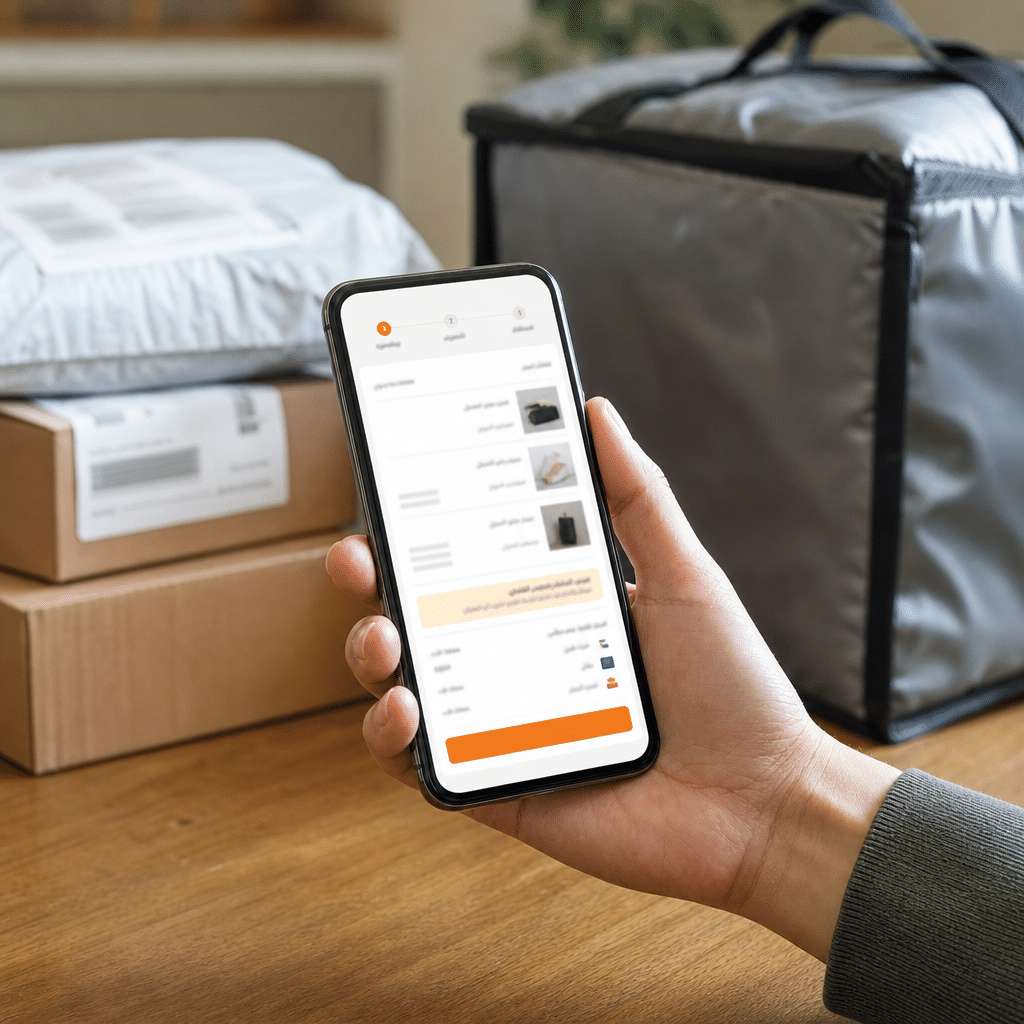
Step 4: Test Arabic/RTL, local logistics and the mobile app experience
Arabic RTL storefront design is where many vendors fall short. Broken mirroring, English-only checkout errors and machine-translated copy cost you trust and sales.
Arabic and RTL testing
- Switch a vendor’s live store to Arabic and complete a purchase.
- Check menus, sliders, arrows, prices and form fields mirror correctly.
- Confirm emails, SMS and invoices go out in Arabic.
- Ask who writes Arabic content: a native copywriter or software.
Local logistics
Ask which carriers they’ve integrated (SPL, Aramex, SMSA and others) and whether rates, tracking and COD sync automatically. Check national address fields and city lists beyond Riyadh, Jeddah and Dammam.
Mobile first, app when justified
Test the responsive store on a mid-range Android phone on mobile data. A native or cross-platform app pays off when you have repeat buyers, loyalty or push campaigns. Ask whether the app shares catalog and inventory with the store, or must be maintained twice.
Step 5: Evaluate evidence, cost, ownership and support
- Portfolio: live Saudi stores on your platform, ideally in your category.
- References: two clients you can call, including one whose project had problems.
- Team: who does the work, in-house or subcontracted.
- Pricing model: fixed scope, time and materials, or retainer.
- Support: response times in Saudi working hours, inclusions and extras.
Indicative SAR planning bands
These are our indicative planning ranges, not quotes or market data. Real prices depend on scope, integrations and catalog size.
| Project size | Typical vendor type | Indicative band (SAR) |
|---|---|---|
| Small store, standard theme, few integrations | Freelancer | 5,000-20,000 |
| Growing brand, custom theme, local payments, Arabic/English | Local agency or Shopify partner | 25,000-80,000 |
| Shopify Plus or WooCommerce with ERP and B2B | Experienced agency | 80,000-250,000 |
| Headless or custom platform | Enterprise or custom agency | 250,000+ |
| Companion mobile app (iOS and Android) | Agency with app team | 40,000-150,000 |
What an itemised quote must include
- Discovery, design, build and QA as separate lines.
- Each integration: gateway, BNPL, carriers, invoicing provider, ERP.
- Paid apps and platform plan fees (monthly, in SAR).
- Content entry, Arabic copywriting and data migration.
- Post-launch support: hours, response times, monthly cost.
- VAT at 15% shown separately, plus payment milestones.
Ownership, data portability and SEO migration
You should own the domain, platform account, theme code, app store accounts and data. Ask for exports of products, customers and orders in CSV and a documented handover. If you’re replatforming, require this SEO migration checklist:
- 301 redirect map from every old URL, including Arabic and English versions.
- Consistent Arabic/English URL structure and hreflang tags.
- Indexability checks: robots.txt, sitemap, no leftover noindex tags.
- Google Analytics and Search Console owned by your account, not the vendor’s.
- Post-launch crawl and ranking monitoring for at least four weeks.
Run a pilot. Before signing the full build, pay for a short paid discovery or a single module (for example, the checkout and payment setup). It shows how the team communicates and delivers at low risk.
Comparison: types of ecommerce vendors in KSA
Each vendor type is right for someone. This compares fit, not price or rank.
| Vendor type | Best for | Strengths | Limitations | Typical considerations |
|---|---|---|---|---|
| Freelancer | Small, simple stores | Low overhead, direct contact | Single point of failure, limited QA, may lack Fatoora or app skills | Insist on account ownership and documentation |
| Local ecommerce agency | Growing brands needing Arabic/RTL, local payments, support | Saudi market knowledge, same time zone | Platform depth varies | Check live KSA stores and support terms |
| Shopify partner/expert | Merchants committed to Shopify or Shopify Plus | Deep platform knowledge, faster launches | Not right for highly bespoke backends | Ask about checkout limits and app costs |
| Global or enterprise agency | Complex bespoke, headless, multi-country | Large teams, architecture depth | Higher overhead, possibly thinner local experience | Confirm who handles Saudi specifics |
| In-house team | Large retailers with continuous roadmaps | Full control | Hiring time, retention | Often paired with an agency for launch |

Ecommerce development company scorecard 2026
Score each vendor 0-5 per criterion, multiply by the weight, and add up. Weights total 20, so the maximum is 100.
| Criterion | Weight | What a 5 looks like | Question to ask |
|---|---|---|---|
| Platform expertise | 4 | Several live KSA stores on your platform, honest about limits | Which KSA stores have you launched? |
| Saudi payments | 3 | Live checkout with every method you need | Can you run a test checkout now, and is STC Pay direct or via the gateway? |
| Fatoora integration | 2 | Clear data flow to your provider, named owner, failure alerts | Who handles ZATCA integration? |
| Arabic/RTL | 3 | Native copy, correct mirroring, Arabic notifications | Who writes and reviews Arabic content? |
| Delivery evidence | 3 | Callable references, written plan, QA, SEO migration process | Can we call two clients, one with a difficult project? |
| Mobile and app | 2 | Fast on mid-range Android; app synced with store | Does the app share catalog and inventory? |
| Support and cost clarity | 2 | Itemised quote, written SLA | What does support cost after launch? |
| Ownership and exit | 1 | You own code, accounts, data, analytics | Who owns the code and accounts? |
Score bands: 85-100 strong shortlist; 70-84 viable, clarify gaps in writing; 55-69 only for simple scope; below 55 decline.
Auto-fail: a score of 0 or 1 on Saudi payments or Fatoora integration removes the vendor, whatever the total.
Where Red Rock Technologies fits
Disclosure: this guide is published by Red Rock Technologies.
Red Rock Technologies is an ecommerce development agency in Al Narjis District, Riyadh, building Shopify, WooCommerce and Magento stores for Saudi businesses. Its Shopify development service covers custom theme design, store setup, app integration, local payment integrations, Arabic RTL and marketing such as on-page SEO and Google Shopping. Its Shopify Plus development covers B2B, Flow maintenance, themes tested on mid-range Android devices and SLA support options.
For apps, the mobile app development team builds Android (Kotlin), iOS (Swift), Flutter and React Native apps with local payment gateways, and the ecommerce mobile app service includes Shopify store sync. Red Rock integrates your chosen Fatoora provider; it is not an e-invoicing provider itself.
Best for: merchants wanting a Shopify build plus a companion mobile app from one team. Not the best fit: complex bespoke platforms, headless or deep enterprise ERP work, where a custom or enterprise agency fits better, and very small, simple stores, where a freelancer is often enough.
Red flags and common mistakes when hiring
- Choosing the lowest quote. Skipped QA and Arabic testing mean paying twice to fix checkout and RTL bugs.
- Accepting payment logos as proof. Broken mada routing found after launch loses orders in peak season.
- Assuming the platform handles Fatoora. You may have no integration when your wave arrives.
- Letting the vendor own accounts or analytics. You can lose your domain, app listing or traffic history.
- Skipping redirects. A replatform without a redirect map can wipe out organic traffic.
- Ignoring support costs. Stores break quietly as apps update. See our guide to ecommerce website maintenance.
- Over-buying headless. Architecture you don’t need raises running costs for years.
Typical project timeline and what to prepare before requesting quotes
Our indicative planning ranges; scope changes them.
| Phase | Typical duration |
|---|---|
| Discovery and scope (or pilot) | 1-3 weeks |
| Design, Arabic and English, mobile first | 2-4 weeks |
| Build, payments and integrations | 3-10 weeks |
| Content, migration, SEO checks and QA | 2-4 weeks |
| Mobile app (if included) | Often parallel; adds several weeks |
Prepare these before you ask for quotes
- Commercial registration, VAT details and your Fatoora wave status.
- Product count, variants and any B2B pricing.
- Payment methods, preferred gateway, BNPL and COD rules.
- Carriers and delivery cities.
- Systems to connect: ERP, POS, accounting, CRM.
- App plans for the next 12 months and reference stores you like.
Weighing platforms? Read Shopify vs WooCommerce for Saudi stores, or our notes on WooCommerce development in Saudi Arabia.
Score your shortlist and request a scoped proposal
Choosing an ecommerce development company in KSA comes down to evidence: the same scorecard, a live checkout demo and an itemised quote from every vendor. If your plan is a Shopify store, a Shopify Plus rebuild or a companion app, send Red Rock’s Riyadh team your requirements with your platform, payment methods, catalog size and Fatoora provider. You’ll get a scoped plan you can score against every other vendor.
FAQ
How do I choose an ecommerce development company in KSA?
Shortlist vendors on working Saudi payments (mada, Apple Pay, STC Pay), ZATCA Fatoora integration capability, platform expertise, Arabic and RTL quality, and post-launch support. Score them with the same scorecard, then verify through live Saudi stores, callable references and an itemised, scoped proposal before signing.
Does Shopify make my store ZATCA compliant?
No storefront platform alone makes you compliant. Fatoora compliance comes from a compliant e-invoicing provider plus correct order data flowing into it. Your developer connects the store to that provider. Check ZATCA's official e-invoicing portal for current Phase 2 wave requirements.
How much does an ecommerce website cost in Saudi Arabia?
As indicative planning bands only: roughly SAR 5,000-20,000 for a simple freelancer build, SAR 25,000-80,000 for an agency Shopify store with local payments, and SAR 80,000+ for Shopify Plus, ERP or custom work. Always request an itemised quote with VAT shown separately.
Can Saudi stores accept mada, Apple Pay and STC Pay together?
Usually yes, depending on your gateway and platform. Gateways such as Moyasar, HyperPay, Tap, PayTabs and Checkout.com are common options, but coverage changes, so confirm supported methods with the provider in writing and ask for a live test checkout.
When should I choose headless commerce instead of Shopify?
Choose headless or custom when you have complex workflows, multiple frontends or deep ERP requirements a SaaS platform cannot handle cleanly. Most Saudi retailers do better on Shopify or Shopify Plus, which cost less to maintain over time.
Who should own the code and accounts after launch?
You should own the domain, platform account, theme code, app store accounts, analytics and customer data. Put it in the contract with data export and handover steps so you can change vendors without losing your store or traffic history.



Comment Reviews
No comments yet. Be the first to comment!