

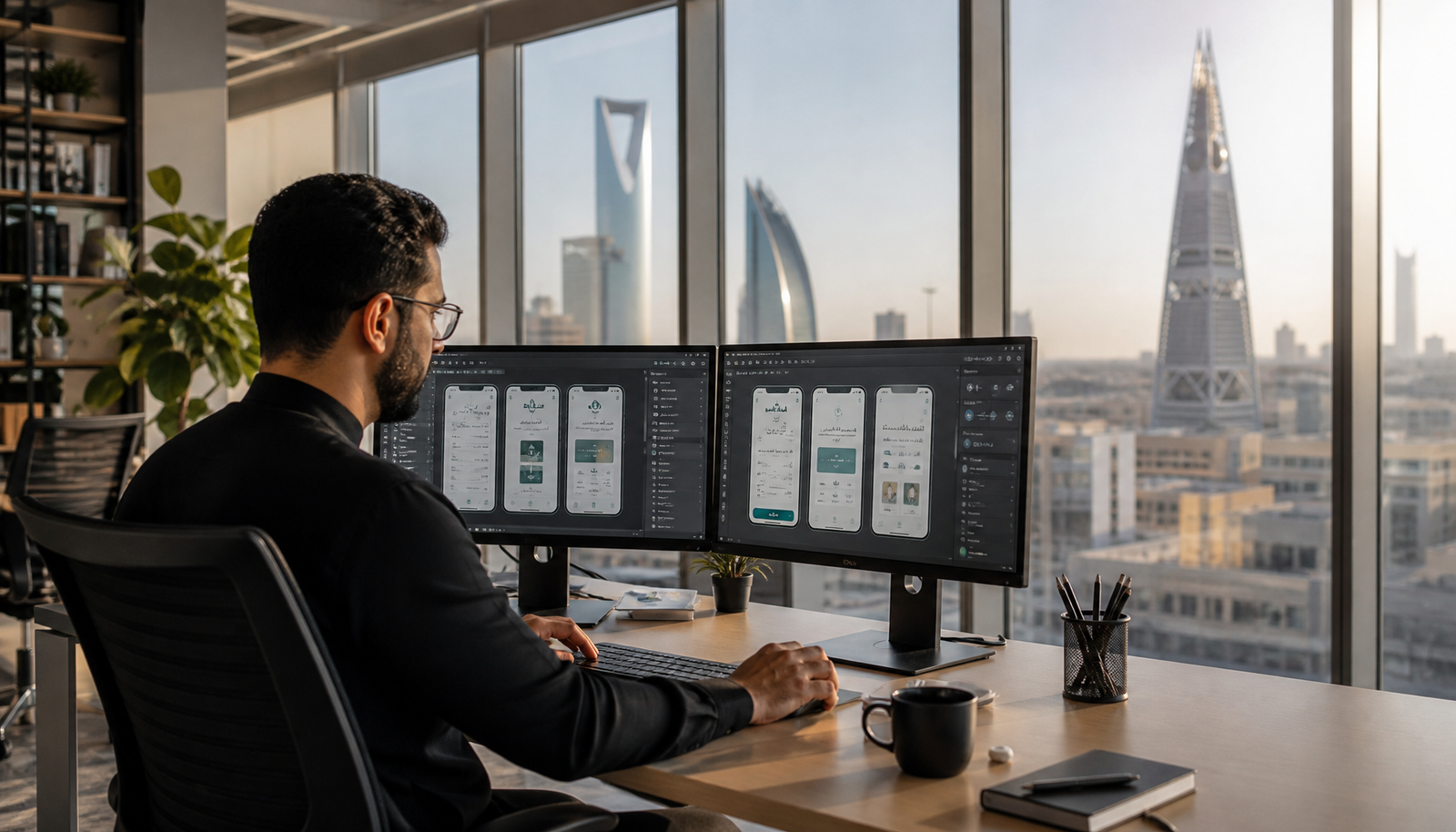
A founder in Riyadh once asked me to review a quote she received for a simple food delivery app. The number on the proposal: SAR 480,000. A competing agency quoted SAR 95,000 for the same scope. Both were legitimate companies. The gap tells you everything about why understanding mobile app development costs in Saudi Arabia is so important before you sign anything.
So, how much does mobile app development cost in Saudi Arabia? The honest answer is: it depends on a set of very specific decisions you make before writing a single line of code. This guide breaks down those decisions in SAR terms, with real cost ranges, a full comparison table, timeline estimates, and a clear path forward whether your budget is SAR 50,000 or SAR 500,000.
By the end, you will know what drives costs up, where you can trim without hurting quality, and what to ask any mobile app company in Riyadh or KSA before committing your budget.
The State of Mobile App Development in Saudi Arabia
Saudi Arabia’s mobile economy is accelerating fast. Smartphone penetration sits above 95%, and Vision 2030 has pushed both public and private sectors to digitize services at a pace few regions match. According to Statista’s mobile app development outlook for Saudi Arabia, the local market is on a strong upward trajectory, with demand growing roughly 15% per year as reported by Research and Markets.
That growth is creating a competitive but sometimes opaque pricing environment. Clutch’s directory of top mobile app developers in Saudi Arabia shows a wide spread of agency sizes and rates. Local Riyadh-based teams typically charge between SAR 185 and SAR 750 per hour depending on seniority and tech stack. Freelance developers on platforms like Upwork often fall in the SAR 130-375 per hour range, as Upwork’s rate data has long documented for the MENA region. The average full-time mobile developer salary in KSA sits around SAR 150,000 per year according to Payscale, which gives you a useful floor when evaluating agency proposals.
How Much Does Mobile App Development Cost in Saudi Arabia? Key Cost Drivers
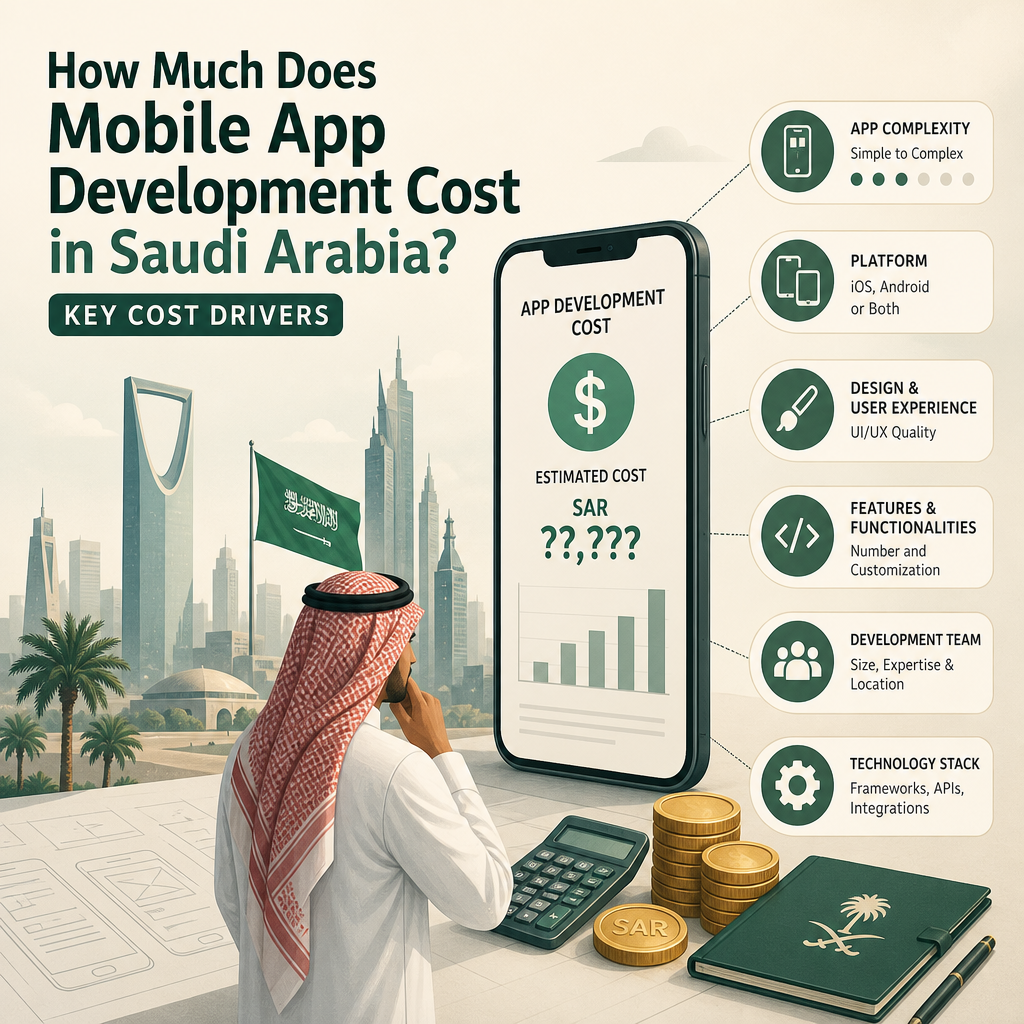
Before looking at any number, you need to understand what actually moves the price. In every project I have reviewed, cost comes down to six levers.
App Complexity and Feature Set
A simple app with five screens and no backend is fundamentally different from a marketplace with payments, real-time chat, and an admin dashboard. More screens, more logic, more time. I have seen a single live-tracking feature add SAR 20,000-40,000 to a project budget because of the GPS polling, server load management, and battery optimization work involved.
Platform Choice: iOS, Android, or Cross-Platform
Building native iOS (Swift, Xcode) and native Android (Kotlin, Android Studio) separately roughly doubles your frontend cost. Cross-platform frameworks like Flutter and React Native let one codebase run on both platforms, typically reducing development time by 30-45%. For most SMB projects in KSA, Flutter app development in Saudi Arabia is the strongest starting point because it offers near-native performance at a meaningfully lower price.
UI/UX Design Quality
Design is not decoration – it is the reason users stay or leave. A basic wireframe-to-prototype process costs SAR 8,000-25,000. A fully polished design system with custom animations, dark mode, and Arabic RTL layouts (more on this below) can reach SAR 50,000-90,000 for a complex app.
Backend Infrastructure and APIs
Most apps need a server to store data, authenticate users, and handle business logic. A simple REST API backend on Firebase or Supabase costs far less than a custom Node.js or Laravel backend with microservices. Third-party API integrations – maps, SMS gateways, payment processors – add per-integration costs of SAR 3,000-15,000 each depending on complexity.
Arabic RTL and Dual-Language Support
This is the most consistently underestimated cost item in KSA projects. Proper Arabic right-to-left (RTL) support is not just flipping text direction. It means redesigning layouts, testing every screen in both languages, adjusting icon placement, handling mixed numerals (Arabic-Indic vs. Western), and often rewriting form validation logic. Budget an additional SAR 15,000-35,000 for a well-executed bilingual Arabic/English app. Shortcuts here will cost you in App Store rejections and user reviews.
Team Location and Seniority
A senior Riyadh-based development team working in-house will cost more per hour than a remote team in Egypt or Pakistan – but local teams bring Saudi market knowledge, easier communication, and alignment with PDPL (Personal Data Protection Law) compliance expectations. For regulated sectors like fintech or healthtech, local expertise is rarely optional.
Mobile App Development Cost Breakdown by App Type (SAR)
The table below reflects realistic market ranges I have seen across KSA projects in 2024-2025. These are not theoretical – they are grounded in actual proposal reviews and completed builds for Saudi businesses.
| App Type | Examples | SAR Cost Range | USD Equivalent | Timeline |
|---|---|---|---|---|
| Simple / MVP | Informational app, basic booking, simple catalogue | SAR 37,000 – SAR 75,000 | $10,000 – $20,000 | 6-12 weeks |
| Medium Complexity | Food delivery, appointment booking, loyalty program | SAR 75,000 – SAR 225,000 | $20,000 – $60,000 | 3-6 months |
| Advanced / Enterprise | Marketplace, fintech, healthtech, logistics platform | SAR 225,000 – SAR 562,000 | $60,000 – $150,000 | 6-12 months |
| Complex Enterprise / Custom Platform | Super-apps, banking platforms, government portals | SAR 562,000+ | $150,000+ | 12-24 months |
GoodFirms’ research on mobile app development costs in Saudi Arabia found that 65% of projects exceed SAR 375,000 in budget – which reflects the dominance of medium-to-advanced builds in a market where basic utility apps rarely justify the investment.
Budget under SAR 150,000? Here is your MVP path. Focus on one core user problem, one platform (Flutter covers both iOS and Android from a single codebase), Firebase for backend, and a single payment gateway integration. Skip advanced animations, complex admin panels, and multi-role user systems for version one. Validate with real users first, then build the rest.
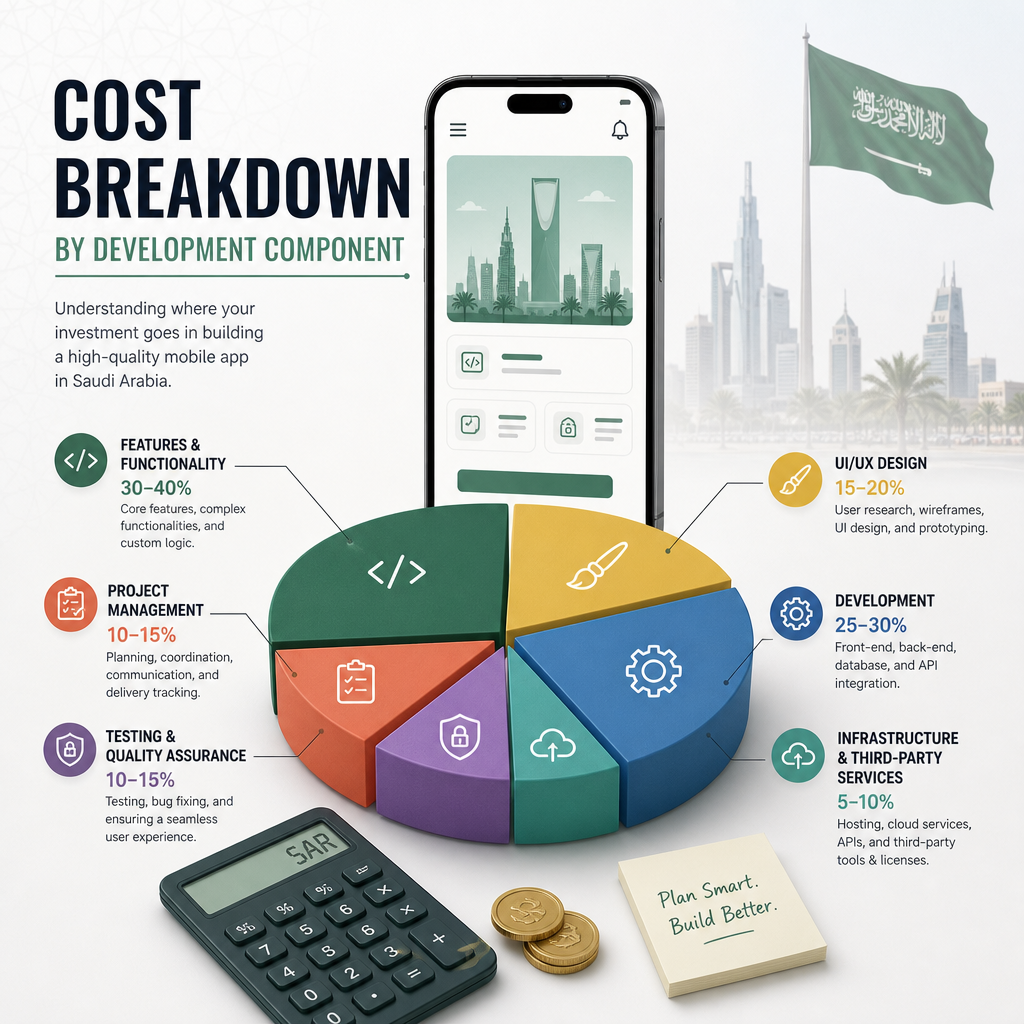
Cost Breakdown by Development Component
Most clients only see the total project number. Breaking it into components helps you negotiate intelligently and prioritize where to invest and where to economize.
UI/UX Design
- Simple app (wireframes + basic UI): SAR 8,000 – SAR 20,000
- Medium app (full design system, prototype): SAR 20,000 – SAR 55,000
- Advanced app (custom animations, Arabic RTL, design system): SAR 55,000 – SAR 110,000
Frontend Development
- Flutter or React Native (cross-platform): SAR 22,000 – SAR 110,000
- Native iOS (Swift/Xcode): SAR 30,000 – SAR 150,000
- Native Android (Kotlin/Android Studio): SAR 28,000 – SAR 140,000
- Native iOS + Android combined: SAR 60,000 – SAR 280,000
Backend Development
- Firebase / Supabase (no-code/low-code backend): SAR 7,500 – SAR 22,000
- Custom REST API (Node.js, Laravel, Django): SAR 22,000 – SAR 90,000
- Microservices / enterprise backend: SAR 90,000 – SAR 280,000+
Third-Party API and Integration Costs
- Google Maps / location services: SAR 3,000 – SAR 8,000
- SMS OTP gateway (Unifonic, Taqnyat): SAR 2,500 – SAR 6,000 setup + per-message fees
- WhatsApp Business API integration: SAR 3,000 – SAR 8,000 (plus monthly API subscription from SAR 150-500/month depending on message volume)
- Push notifications (Firebase FCM): SAR 2,000 – SAR 5,000
- ERP / CRM integration (SAP, Salesforce): SAR 15,000 – SAR 60,000
Quality Assurance and Testing
- Manual QA (basic): SAR 7,500 – SAR 22,000
- Automated testing suite: SAR 18,000 – SAR 55,000
- Performance + load testing: SAR 7,500 – SAR 22,000
- Arabic/RTL regression testing: SAR 5,000 – SAR 15,000
Payment Gateway Integration Costs in KSA
Payment integration is one of the most business-critical – and most frequently mispriced – components in Saudi app projects. Here is what each major gateway actually costs to integrate, beyond the per-transaction fees.
| Payment Gateway | Setup / Integration Cost (SAR) | Monthly Fee (SAR) | Transaction Fee | Notes |
|---|---|---|---|---|
| Mada | SAR 4,000 – SAR 10,000 | SAR 0 – SAR 300 (via aggregator) | 1.5% – 2.5% | Essential for KSA debit card users; requires Saudi bank merchant account |
| STC Pay | SAR 3,500 – SAR 9,000 | SAR 0 – SAR 200 | 1.5% – 2.0% | Strong adoption with younger KSA users; API documentation is in Arabic |
| Tamara (BNPL) | SAR 5,000 – SAR 12,000 | SAR 0 (revenue share model) | 2.5% – 4.0% | Buy Now Pay Later; increases average order value for retail/e-commerce apps |
| HyperPay | SAR 3,000 – SAR 8,000 | SAR 150 – SAR 400 | 2.0% – 2.9% | Popular aggregator supporting Mada, Visa, Mastercard, AMEX in one integration |
| PayTabs | SAR 2,500 – SAR 7,000 | SAR 0 – SAR 300 | 2.0% – 2.85% | Good documentation, supports recurring billing for subscription apps |
A practical tip from working on KSA e-commerce and on-demand apps: always integrate Mada as a priority. A significant portion of Saudi users prefer debit over credit, and missing Mada will visibly hurt your conversion rate. STC Pay is your second priority for consumer-facing apps targeting under-35 users.
App Store Registration and Publishing Costs
App Store Registration Costs – Quick Reference
Apple App Store (iOS): USD 99/year (approx. SAR 371/year) – requires an Apple Developer account. One-time enrollment, annual renewal.
Google Play Store (Android): USD 25 one-time fee (approx. SAR 94) – no annual renewal.
Huawei AppGallery: Free developer registration – relevant for KSA given Huawei device market share.
Factor in SAR 500-2,000 for app submission preparation (screenshots, descriptions in Arabic and English, compliance review) if your agency handles this separately.
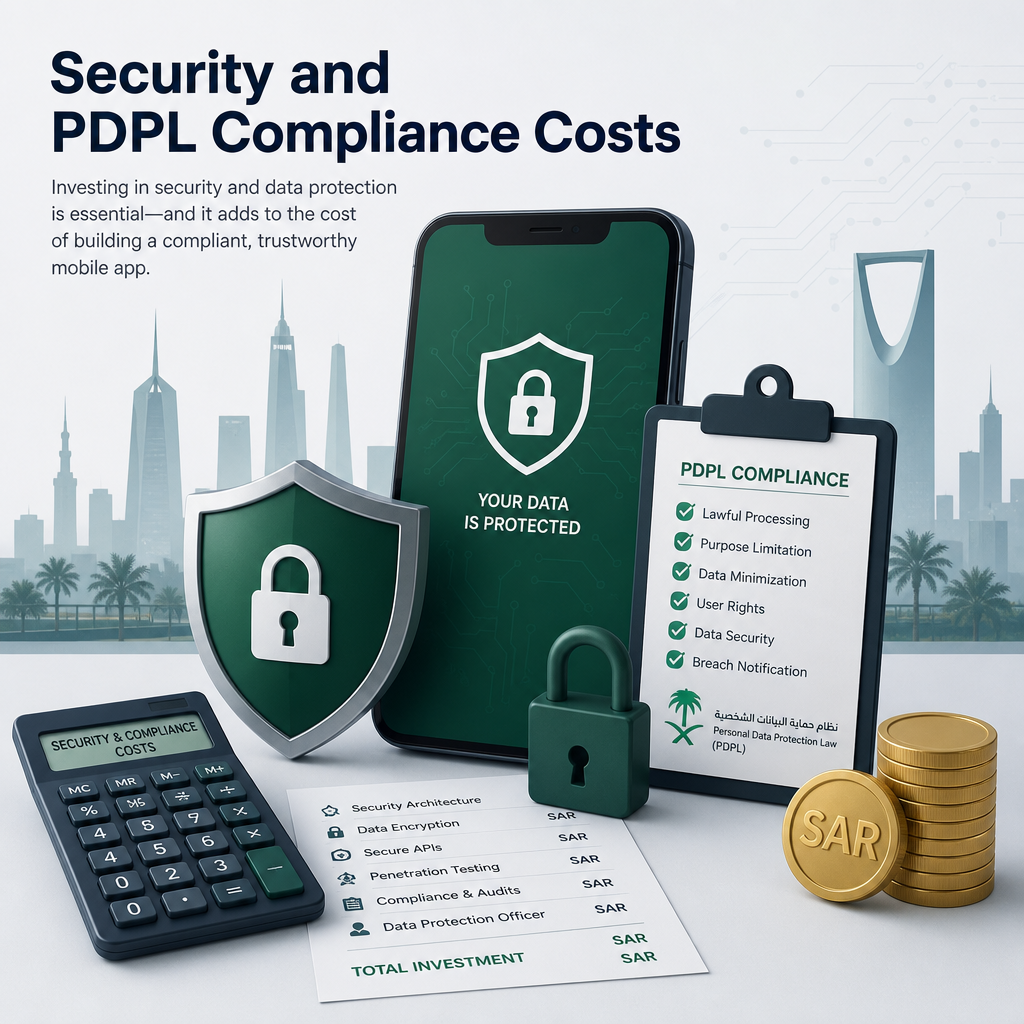
Security and PDPL Compliance Costs
Saudi Arabia’s Personal Data Protection Law (PDPL) came into force in 2023 and applies to any app collecting user data from Saudi residents. Non-compliance risks fines up to SAR 5,000,000 for serious violations. From experience reviewing KSA app projects, here are the itemized compliance costs most teams skip budgeting for:
- Data protection audit and gap analysis: SAR 8,000 – SAR 20,000 (one-time, by a qualified consultant or legal firm)
- Encryption implementation (data at rest and in transit, AES-256, TLS 1.3): SAR 5,000 – SAR 15,000 development cost
- Consent flow design and implementation (Arabic/English cookie banners, data collection consent screens, opt-out mechanisms): SAR 4,000 – SAR 12,000
- Privacy policy drafting (bilingual, PDPL-compliant): SAR 3,000 – SAR 8,000 (legal drafting)
- Penetration testing (required for fintech and healthtech apps): SAR 15,000 – SAR 45,000
- Ongoing security monitoring: SAR 2,000 – SAR 8,000 per month
For fintech or healthtech apps, SAMA (Saudi Central Bank) or MOH compliance requirements add a further layer. Budget an additional SAR 30,000-100,000 for sector-specific regulatory work in these verticals.
Flutter vs. React Native vs. Native: Which Is Right for KSA Projects?
This is the question I get most from founders comparing quotes from different mobile app companies in Riyadh. Here is the honest breakdown for the Saudi market specifically.
Flutter App Development in Saudi Arabia
Flutter (Google’s framework using the Dart language) produces a single codebase that compiles to native iOS and Android. Performance is close to native, and the widget system makes Arabic RTL support more predictable than React Native’s. I have seen Flutter projects delivered 25-40% faster than equivalent native builds. For most new KSA apps with budgets under SAR 300,000, Flutter is the default recommendation.
React Native
React Native uses JavaScript and is excellent if your team already knows it or you need to share code with a web frontend. The Arabic text rendering has improved significantly in recent versions. React Native is a strong choice for apps that need to share business logic with a web app – common in Riyadh-based SaaS products.
Native iOS (Swift) and Android (Kotlin)
Native development gives you maximum performance and access to every platform API. It costs more and takes longer, but for apps where hardware integration (biometrics, NFC payments, camera processing) is central to the product, native is worth the premium. Banking apps targeting SAMA compliance often go native for security audit confidence.
| Framework | Relative Cost | Arabic RTL Support | Performance | Best For |
|---|---|---|---|---|
| Flutter | SAR (base) | Good | Near-native | Most KSA SMB apps, MVPs |
| React Native | SAR (base +5-10%) | Good (recent versions) | Near-native | SaaS apps, web+mobile shared logic |
| Native iOS + Android | SAR (base x1.8-2.2) | Excellent | Best | Fintech, healthtech, hardware integration |
Annual Maintenance and Post-Launch Costs
Maintenance is the budget line most founders forget to model. An app is not a one-time purchase – it requires ongoing investment to stay functional, secure, and relevant. Based on standard KSA agency contracts, annual maintenance runs 15-25% of the original development cost.
- Basic maintenance (bug fixes, OS updates, minor changes): SAR 12,000 – SAR 37,000/year
- Standard support (above + feature updates, server management): SAR 37,000 – SAR 90,000/year
- Full managed service (dedicated team, SLA, 24/7 monitoring): SAR 90,000 – SAR 225,000+/year
- Server/cloud hosting (AWS, Google Cloud, or local Saudi cloud providers): SAR 3,000 – SAR 22,000/year depending on user load
- Third-party API subscriptions: SAR 2,000 – SAR 15,000/year depending on integrations
If you are building on an e-commerce platform and adding a companion mobile app, maintenance costs can sometimes be consolidated with your platform hosting costs – worth asking your agency about bundled retainers.
Real Project Cost Examples from KSA
Abstract ranges help, but concrete examples sharpen your calibration. These are representative builds, with details adjusted to protect client confidentiality.
Simple Service Booking App – Riyadh, SMB
A home maintenance services company in Riyadh needed a booking app allowing customers to schedule technicians, pay online via Mada, and receive SMS confirmations. Built in Flutter with a Firebase backend. Total cost: SAR 68,000. Timeline: 10 weeks. The Arabic/English bilingual requirement added about SAR 12,000 to what would otherwise have been a SAR 56,000 project.
Food Delivery MVP – Jeddah
A cloud kitchen operator in Jeddah wanted a delivery app with real-time order tracking, driver management, and STC Pay plus Mada payment integration. Built on React Native with a custom Node.js backend. Total: SAR 185,000. Timeline: 5 months. The live tracking feature alone accounted for SAR 32,000 of that budget.
B2B Marketplace – Riyadh Enterprise
A procurement platform connecting Saudi manufacturers with regional buyers. Multi-role users (buyer, seller, admin), Arabic contract generation, SAP integration, and PDPL compliance audit included. Total: SAR 520,000. Timeline: 11 months. The SAP integration and compliance work made up nearly SAR 140,000 of the total.
How to Choose a Mobile App Company in Riyadh or KSA
Knowing the numbers is only half the battle. Choosing the right partner for your app development price in KSA matters just as much. Here is what to evaluate before signing.
- Portfolio with KSA projects: Ask for apps they have published to the Saudi App Store or Google Play, with references you can contact.
- Arabic RTL experience: Request screenshots or a demo of a bilingual app they have built. If they cannot show one, that is a red flag for KSA-specific projects.
- PDPL awareness: Any competent KSA agency should be able to describe their standard data handling practices without you asking twice.
- Fixed price vs. time-and-materials: Fixed price contracts work for well-defined scopes. Time-and-materials is better for exploratory or evolving product builds. Both are legitimate – understand what you are signing.
- Post-launch support terms: Get the maintenance SLA in writing before the project starts, not after launch.
If you are comparing proposals and one quote is dramatically lower than others, ask the agency to walk you through their estimate line by line. Either they have found a genuine efficiency (great), or they are underscoping and will charge you for change orders later (common). Our development team in Saudi Arabia always provides itemized quotes for this reason.
Outsourcing vs. Local Development in Saudi Arabia
Outsourcing app development to teams in Egypt, India, or Pakistan can reduce upfront costs significantly – sometimes by 40-60%. But for Saudi-market apps, the trade-offs are real.
- Arabic RTL quality is often lower from teams without native Arabic speakers on staff.
- PDPL compliance knowledge is rarer outside KSA-experienced teams.
- Time zone gaps slow down feedback cycles, adding calendar time even if billable hours are cheaper.
- Saudi payment gateway relationships (especially Mada and STC Pay merchant accounts) are easier to navigate with a local agency.
A hybrid model – local project management and QA with offshore development – often delivers the best cost-to-quality ratio for medium-complexity KSA apps. Your mobile app development partner in Riyadh should be able to explain their delivery model transparently.
Key Takeaways
- How much does mobile app development cost in Saudi Arabia depends primarily on complexity, platform choice, and Arabic/bilingual requirements – not just market rates.
- Simple MVP apps start at SAR 37,000-75,000. Medium-complexity apps run SAR 75,000-225,000. Enterprise builds start at SAR 225,000 and scale from there.
- Flutter app development in Saudi Arabia gives most SMBs the best value: one codebase, near-native performance, reasonable Arabic RTL support.
- Always budget for Mada and STC Pay gateway integration separately – they are not optional in the KSA market.
- Arabic RTL support, bilingual design, and PDPL compliance add real cost. Build them into your budget from day one, not as afterthoughts.
- Annual maintenance is 15-25% of development cost. Factor this into your total cost of ownership from the start.
- A line-item proposal protects you far better than a single lump-sum quote.
Get a Custom Quote for Your App
Every project is different, and generic ranges only get you so far. If you have a specific app idea and want a detailed, itemized estimate for your KSA business, our team can provide a no-obligation scoping session. We work with businesses across Riyadh, Jeddah, and the wider Gulf region on e-commerce and custom app development projects.
Tell us your app idea, your target users, and your rough budget range, and we will come back to you with a honest, itemized estimate – not a number pulled from a template. Reach out through our contact page or start the conversation in the comments below. Building something in KSA should start with clarity, not confusion.
FAQ
How much does a basic mobile app cost in Saudi Arabia in SAR?
A basic mobile app in Saudi Arabia typically costs between SAR 37,000 and SAR 75,000. This covers a simple Flutter or React Native build with Firebase backend, one payment gateway (such as Mada), and bilingual Arabic/English support. Timelines run 6-12 weeks for a well-scoped MVP.
Is Flutter app development cheaper than native iOS and Android in KSA?
Yes. Flutter uses a single codebase for both iOS and Android, reducing frontend development cost by 30-45% compared to building native apps separately. For most Saudi SMB projects, Flutter delivers near-native performance at a significantly lower app development price in KSA.
What payment gateways should a Saudi app support and what do they cost to integrate?
Mada is essential for KSA users who primarily use debit cards, with integration costing SAR 4,000-10,000. STC Pay is important for younger users at SAR 3,500-9,000. Tamara adds Buy Now Pay Later functionality for SAR 5,000-12,000. HyperPay and PayTabs are popular aggregators that bundle multiple methods in one integration.
Does my Saudi app need to comply with PDPL and what does compliance cost?
Yes. Saudi Arabia's Personal Data Protection Law applies to any app collecting data from Saudi residents. Compliance costs include a data audit (SAR 8,000-20,000), encryption implementation (SAR 5,000-15,000), consent flow design (SAR 4,000-12,000), and privacy policy drafting (SAR 3,000-8,000). Fintech and healthtech apps face additional sector-specific requirements.
How much extra does Arabic RTL support add to app development cost?
Proper Arabic right-to-left support, including bilingual UI design, layout mirroring, mixed numeral handling, and Arabic regression testing, typically adds SAR 15,000-35,000 to a project. This is not optional for any consumer-facing app in the Saudi market and affects both development and QA timelines.
How much does it cost to maintain a mobile app in Saudi Arabia annually?
Annual maintenance in KSA typically runs 15-25% of the original development cost. Basic maintenance covering bug fixes and OS updates costs SAR 12,000-37,000 per year. Full managed service with a dedicated team and SLA can reach SAR 90,000-225,000 per year, plus server hosting of SAR 3,000-22,000 depending on user load.
Should I choose a local Riyadh mobile app company or outsource to a cheaper international team?
Local agencies offer stronger Arabic RTL quality, PDPL compliance knowledge, and easier KSA payment gateway relationships. International teams can cost 40-60% less upfront. A hybrid model, with local project management and offshore development, often delivers the best balance for medium-complexity Saudi app projects.