



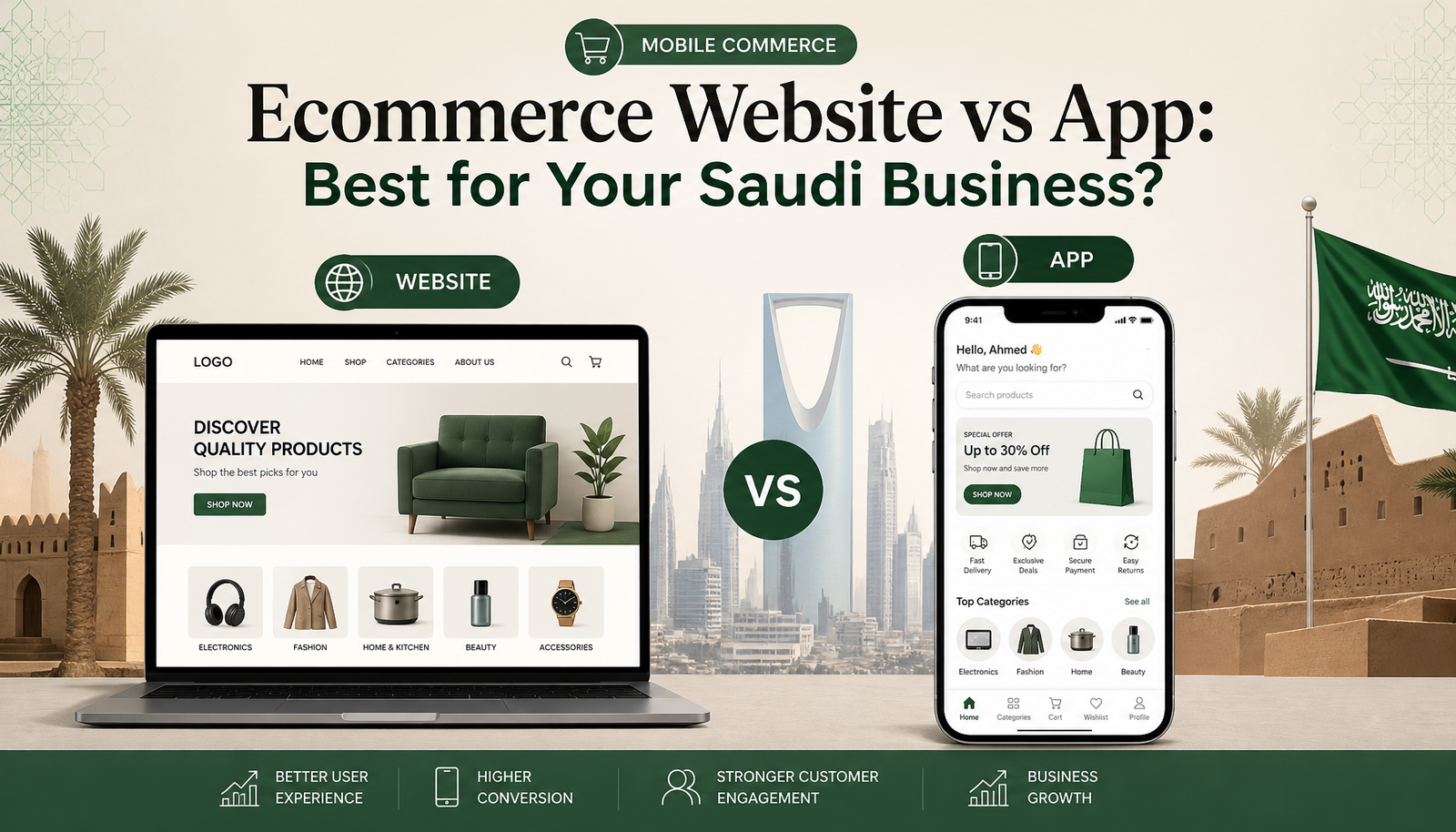
Saudi Arabia’s internet penetration hit 99% in 2024, and smartphone adoption now exceeds 95% of the population, according to GSMA Intelligence’s Mobile Economy Report. Over 70% of online retail activity in the Kingdom flows through mobile devices. If you sell online, your customer is almost certainly on a phone right now – browsing, comparing prices, and deciding whether to buy from you or a competitor.
That reality forces a decision every Saudi e-commerce business must eventually make: do you invest in a responsive e-commerce website, a Progressive Web App (PWA), or a dedicated native mobile app? Each path carries a different cost, reaches a different audience, and produces a different result for retention, conversion, and long-term growth.
This guide gives you a clear framework for that decision. You will see honest cost ranges (VAT-inclusive), platform trade-offs, business scenarios, and a concrete decision table built specifically for the Saudi market. No vague generalities – just the consulting-level thinking you need to allocate your riyal correctly.
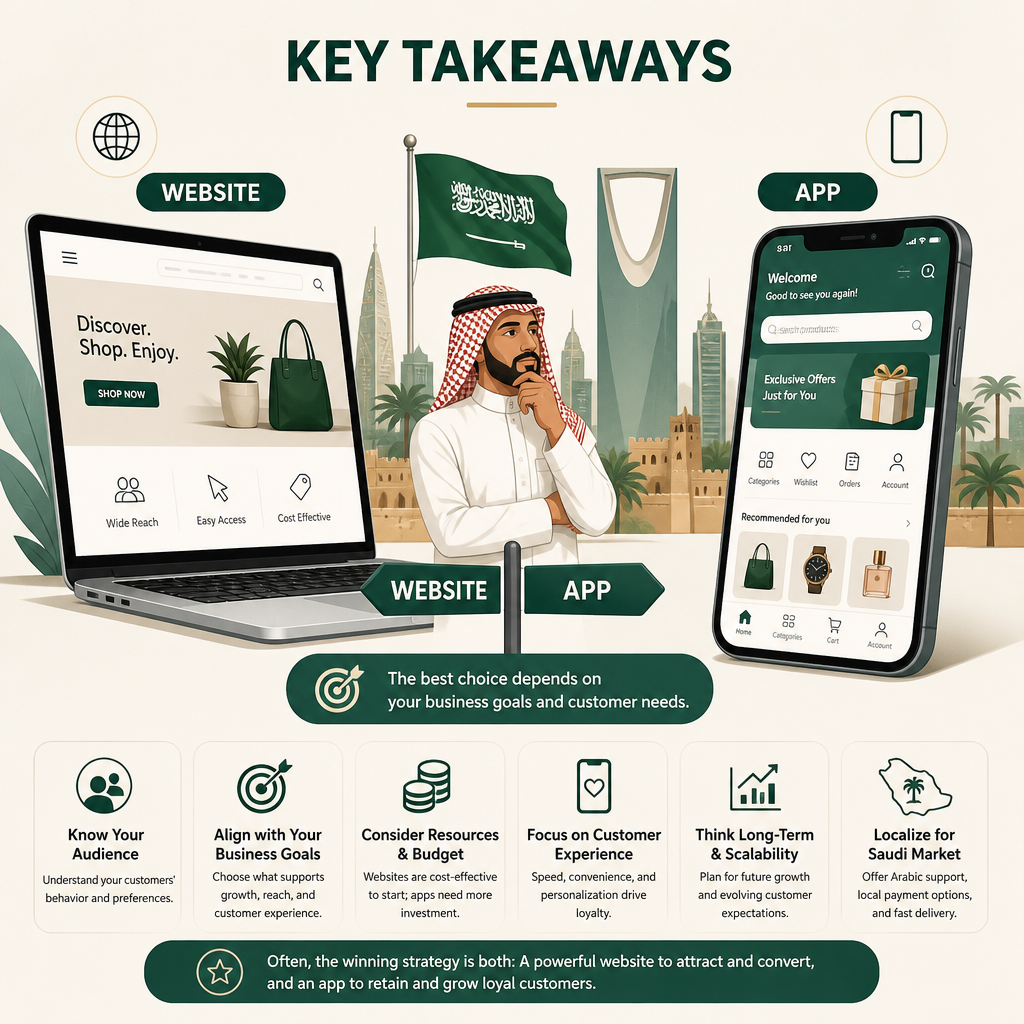
Key Takeaways
- A responsive website is the non-negotiable foundation. Every Saudi business needs one before considering an app.
- PWAs close 80% of the gap between websites and native apps at roughly 30-40% of the cost – but have a critical iOS push notification limitation that affects high-value Saudi shoppers.
- Native apps deliver 3-4x higher retention and 2x better conversion for established brands with repeat-purchase audiences, but require a minimum monthly active user base to justify the investment.
- ZATCA e-invoicing compliance applies to all three channels. Your checkout must generate a Fatoora-compliant VAT invoice regardless of the platform you choose.
- The right answer depends on your monthly orders, average basket size, and customer lifetime value – not on what your competitors are doing.
The Saudi Mobile Commerce Context: Why This Decision Matters More Here
Saudi Arabia is not a typical emerging market. The Communications and Information Technology Commission (CITC) consistently reports among the highest mobile data consumption rates in the world. Saudi users spend an average of 7+ hours per day on their phones, and the 18-45 age bracket – the core online shopping demographic – expects fast, frictionless digital experiences as a baseline, not a premium.
Payment infrastructure has matured rapidly. Mada (the national debit network) processes the majority of online transactions. Apple Pay and STC Pay are mainstream. Buy-now-pay-later services like Tamara and Tabby have significant adoption. Any platform you choose must integrate these payment gateways natively – a checkout that forces users to type in a 16-digit card number on mobile will lose Saudi shoppers at a higher rate than almost any other market.
ZATCA’s Phase 2 e-invoicing (Fatoora) mandate means your platform must generate a compliant XML invoice with a QR code at the point of sale, in real time. This applies whether you are running a Shopify store, a WooCommerce site, or a custom React Native app. Budget for this compliance layer if it is not already built into your chosen platform.
Option 1: Responsive E-commerce Website
A responsive website automatically adapts its layout to any screen size. Built on platforms like Shopify, WooCommerce, or Magento, it is indexed by Google, accessible without download, and reachable by any user with a browser. For most Saudi SMBs, this is where e-commerce starts.
Cost Range (VAT-inclusive at 15%)
- Shopify Basic/Grow plan with a professional theme: SAR 900-2,500 setup + SAR 230-600/month (including Shopify fees, VAT, and a local payment gateway)
- Custom WooCommerce or Magento build: SAR 15,000-85,000 one-time development cost + SAR 500-2,000/month hosting and maintenance, all VAT-inclusive
- Enterprise Magento Commerce: SAR 120,000-400,000+ depending on integrations (ERP, warehouse management, multi-store Arabic/English)
Strengths for the Saudi Market
- Zero friction to start: A user finds you on Google, lands on your product page, and buys – no download required. Saudi consumers searching for products on Google or Bing reach your site directly.
- SEO visibility: Product pages, category pages, and blog content all index. This is how most new customers discover SMBs in KSA without paid advertising.
- Arabic RTL support: Shopify, WooCommerce, and Magento all support right-to-left Arabic layouts with proper font rendering. A well-built Arabic-English bilingual site converts significantly better in Saudi markets than an English-only store.
- Mada, Apple Pay, STC Pay integration: All major Saudi payment gateways (HyperPay, PayTabs, Moyasar) integrate cleanly with the main platforms.
Weaknesses
- No push notifications (standard websites cannot send alerts to past visitors).
- Slower load times on poor connectivity compared to a cached native app.
- Lower repeat-purchase rates compared to apps because there is no persistent icon on the user’s home screen.
Option 2: Progressive Web App (PWA)
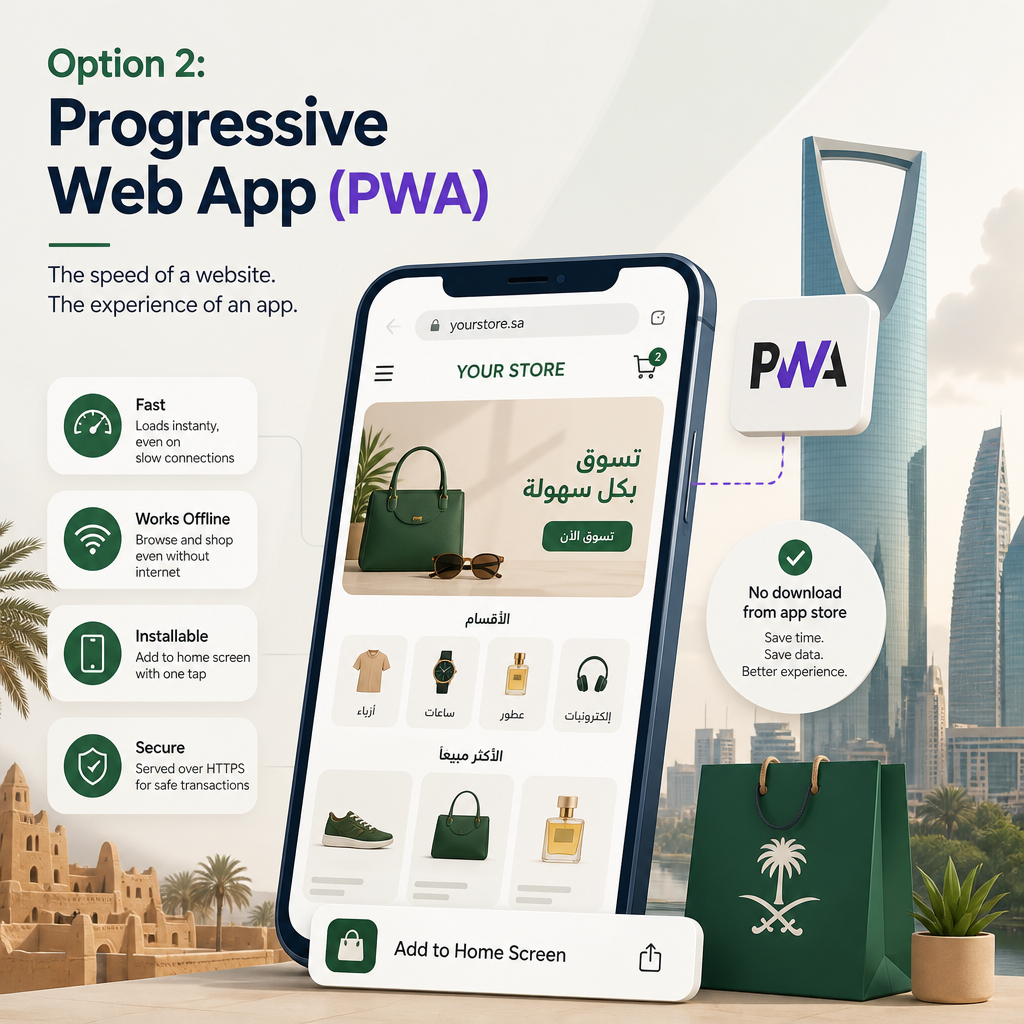
A PWA is a website that behaves like an app. Users can add it to their home screen, it caches content for faster loading, and it can work partially offline. For the ecommerce website vs app Saudi debate, PWAs occupy a compelling middle ground – but one with a critical limitation that Saudi businesses must understand before committing.
Cost Range (VAT-inclusive)
- PWA layer on existing Shopify/WooCommerce: SAR 18,000-45,000 one-time development
- Headless PWA with custom backend: SAR 60,000-180,000 depending on complexity
- Ongoing maintenance: SAR 2,000-6,000/month
The iOS Push Notification Problem – Critical for Saudi Businesses
Here is the fact that many PWA vendors omit: iPhone users do not receive PWA push notifications unless they have manually added the PWA to their home screen AND are running iOS 16.4 or later. The opt-in rate for this behavior is very low in practice – typically under 10% of iPhone visitors.
This matters enormously in Saudi Arabia. iPhone market share among the 25-45 age group – the highest-spending segment in KSA e-commerce – is substantial. If your growth strategy depends on push notifications to drive repeat purchases, a PWA alone will miss a large share of your most valuable customers. Any brand targeting this segment seriously should treat a native iOS app as a required complement to a PWA, not an optional upgrade.
What PWAs Do Well
- Android push notifications work reliably, reaching users with Samsung, Xiaomi, and OPPO devices (which dominate the mid-range Saudi market).
- Home screen installation without an app store gives users the feel of an app without the download barrier.
- Page load speeds improve significantly through service worker caching – important for Saudi users on variable 4G connections outside Riyadh and Jeddah.
- A single codebase serves web and “app” users, reducing maintenance cost compared to maintaining separate iOS and Android apps.
Featured Snippet Answer – What is a PWA for e-commerce? A Progressive Web App (PWA) is a website built with technologies that let it behave like a mobile app – it loads fast, works partially offline, and can be added to a phone’s home screen. For Saudi e-commerce businesses, a PWA delivers app-like speed at roughly 30-40% of the cost of building a native iOS and Android app.
Option 3: Native or Cross-Platform Mobile App
A native app is built specifically for iOS (Swift) or Android (Kotlin), or developed cross-platform using React Native or Flutter. It is distributed through the Apple App Store and Google Play Store. For established Saudi e-commerce brands with a proven repeat-purchase customer base, native apps are the highest-performing channel for retention and conversion.
Cost Range (VAT-inclusive)
- React Native or Flutter cross-platform app (iOS + Android): SAR 80,000-200,000 development + SAR 4,000-10,000/month maintenance
- Fully native iOS + Android (separate codebases): SAR 200,000-500,000+ development
- App store fees: Apple Developer Program SAR 375/year; Google Play SAR 94 one-time (both VAT-exclusive – add 15%)
- Post-launch app store optimization and user acquisition: Budget SAR 8,000-25,000/month in paid installs if you are starting from zero
Why Native Apps Win on Retention
The retention advantage of native apps is not a marketing claim – it is structural. A home screen icon creates daily visual reinforcement. Push notifications for price drops, back-in-stock alerts, and order updates are delivered reliably to both iPhone and Android users. The checkout experience can use Face ID or Touch ID for payment authentication, which reduces friction at the most critical moment of the purchase journey.
Research in mobile commerce consistently shows that app users have 3-4x higher 90-day retention rates than mobile web users, and convert at roughly 2x the rate on a per-session basis. For a Saudi fashion retailer with an average basket of SAR 450, moving 1,000 monthly app users from a 15% conversion rate to a 30% conversion rate adds SAR 67,500 in monthly revenue from the same traffic – before any increase in spend.
Loyalty Programs and Gamification
Native apps unlock loyalty mechanics that websites and PWAs cannot replicate at the same quality level. In-app loyalty points, tiered reward tiers (Bronze, Silver, Gold), stamp cards, and gamified daily check-in bonuses are all significantly easier to build and maintain inside a native app environment. Saudi shoppers respond strongly to loyalty programs – look at how Panda Retail’s app and Al-Baik’s loyalty system have driven habitual repeat behavior. An SMB does not need Al-Baik’s scale to apply the same psychology: a straightforward points-per-riyal system with a redeemable reward at 500 points is buildable in React Native for a fraction of a full custom iOS app cost.
App Store Discovery and Trust Signals
A published app on the Apple App Store and Google Play carries a trust signal that matters to Saudi consumers. Reviews, ratings, and the visual presence of a branded app icon signal legitimacy – particularly for businesses in fashion, electronics, and health products where purchase anxiety is higher. This is a soft benefit, but it is real and measurable through post-install survey data.
Head-to-Head Comparison: The Factors That Matter
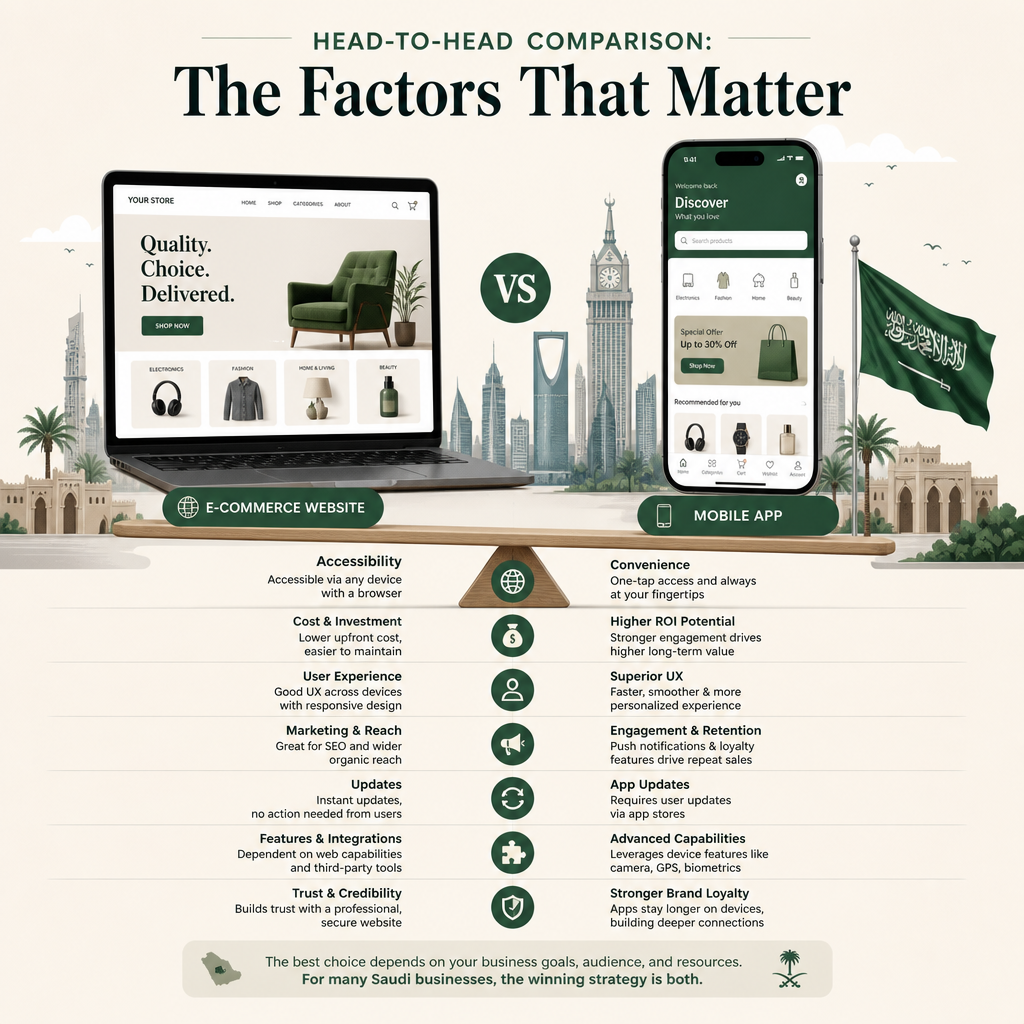
Performance and Mobile Checkout
Native apps are fastest. Service worker caching in PWAs comes close for returning visitors. A well-optimized Shopify or WooCommerce site on a good CDN (Cloudflare, for example) is adequate but slower for first-time visitors on variable connections. For Saudi users in Riyadh and Jeddah on 5G, the difference is minimal. For users in Al-Khobar, Abha, or Tabuk on 4G with variable signal, PWA and native apps provide a measurably better checkout experience.
Push Notifications
Native apps: full push notifications on iOS and Android, with high delivery rates and rich media support. PWAs: reliable on Android, near-zero practical reach on iPhone (see iOS limitation above). Responsive websites: no push notifications at all (email and SMS are the substitutes, and both require explicit opt-in).
Reach vs. Retention
Websites reach the most people – anyone with a URL. PWAs add home screen convenience for Android users. Native apps trade reach (fewer people download an app than visit a website) for dramatically higher retention among those who do install. The correct framing: use a website or PWA to acquire customers, and use a native app to retain your best ones.
Maintenance Burden
A Shopify or WooCommerce site on a managed host requires the least ongoing technical work. A PWA requires occasional service worker updates and compatibility testing. A native app requires separate updates for iOS and Android, app store review cycles (Apple typically takes 24-72 hours), and OS compatibility testing every time Apple or Google releases a major update. Budget 10-15% of the initial development cost annually for native app maintenance.
Decision Table: Ecommerce Website vs App Saudi Business Scenarios
Use this table to identify which solution fits your current situation. The “right” answer changes as your business grows.
- Stage 1 – New business, under SAR 50,000 monthly revenue: Responsive website (Shopify or WooCommerce). Focus 100% of budget on getting orders and proving product-market fit. Do not build an app yet.
- Stage 2 – Growing business, SAR 50,000-200,000 monthly revenue, 40%+ repeat customer rate: Add a PWA layer to your existing site. Capture Android push notification subscribers. Monitor iOS traffic share; if iPhone users exceed 40% of your repeat buyers, plan a native iOS app.
- Stage 3 – Established business, SAR 200,000+ monthly revenue, strong brand loyalty: Build a cross-platform React Native or Flutter app. Invest in a loyalty program within the app. Use the website and PWA for acquisition; use the app for retention and lifetime value growth.
- Stage 4 – Multi-category retailer or marketplace, SAR 1M+ monthly revenue: Full native iOS + Android with a separate web storefront. Consider headless commerce architecture (Shopify Hydrogen, Magento PWA Studio) that serves both simultaneously from one product catalog.
- B2B or wholesale buyer: Responsive website with a customer portal is almost always sufficient. B2B buyers use desktop at higher rates than B2C; app investment rarely pays back at SMB scale.
- Restaurant or food delivery (QSR): Native app with loyalty points is the standard in Saudi Arabia (as demonstrated by Hungerstation, Jahez, and local QSR brands). The repeat purchase frequency (weekly to daily) justifies app investment at far lower revenue thresholds than fashion or electronics.
- Subscription box or auto-replenishment: Native app or PWA with strong notification capability. Subscription renewal reminders via push notification reduce churn meaningfully compared to email alone.
Cost vs. Benefit Summary Table
- Responsive Website: SAR 15,000-85,000 one-time (VAT-inclusive) | Highest reach | Lowest retention | Best for new businesses and SEO-driven acquisition
- PWA: SAR 18,000-180,000 (VAT-inclusive) | High reach | Moderate retention (Android-strong) | Best for growing businesses with Android-heavy audiences
- Cross-platform App (React Native/Flutter): SAR 80,000-200,000 (VAT-inclusive) | Medium reach | Highest retention | Best for established brands with repeat-purchase customers
- Full Native iOS + Android: SAR 200,000-500,000+ (VAT-inclusive) | Medium reach | Highest performance and retention | Best for large-scale retailers and marketplaces
ZATCA E-Invoicing: What Every Channel Must Do
Featured Snippet Answer – Does ZATCA apply to mobile apps? Yes. Saudi Arabia’s ZATCA Fatoora e-invoicing mandate applies to all B2C and B2B transactions regardless of sales channel. Whether you sell through a Shopify website, a PWA, or a native iOS app, every checkout must generate a ZATCA-compliant XML invoice with a QR code. Non-compliance carries financial penalties. Verify your platform’s ZATCA integration before launch.
Shopify has ZATCA-compliant apps available in the Shopify App Store (look for apps certified for Phase 2 integration). WooCommerce requires a third-party plugin (several Saudi-market plugins are available). For custom native apps, ZATCA compliance must be built into the backend API layer – it is not a front-end concern, but it must be tested end-to-end before going live.
All prices in this article are quoted VAT-inclusive at 15%. When requesting development quotes from agencies, always ask for a VAT-inclusive breakdown to compare accurately. A SAR 100,000 quote excluding VAT becomes SAR 115,000 – a meaningful difference when comparing multiple vendors.
When Does an App Become Worthwhile for a Saudi Business?
The honest answer: an app becomes worthwhile when the additional revenue it generates (through higher retention, push notification-driven repurchase, and improved conversion) exceeds the total cost of building and maintaining it within a reasonable payback period – typically 18-24 months for a Saudi SMB.
Run this simple calculation before committing. Take your current monthly repeat-purchase revenue from mobile users. Apply a conservative 20% uplift from better retention (a number the industry data supports consistently). Divide the total development cost (SAR 92,000 for a React Native app at the low end, VAT-inclusive) by that monthly uplift figure. If the payback period is under 24 months, the investment makes financial sense.
Example: A Riyadh-based home goods retailer generates SAR 180,000/month from mobile repeat buyers. A 20% retention uplift adds SAR 36,000/month. At SAR 92,000 development cost, the payback period is approximately 2.5 months. That is a clear go decision. If the same retailer generates only SAR 30,000/month from mobile repeats, the uplift is SAR 6,000/month and the payback stretches to over 15 months – still potentially worthwhile, but now competing with other uses of that capital.
For Shopify store development in Saudi Arabia, the platform’s ecosystem gives you a faster path to PWA-level performance through apps like Tapcart (which converts a Shopify store into a branded native app) at a fraction of custom build costs. Tapcart pricing starts at roughly SAR 1,500-3,000/month – worth evaluating before commissioning a full custom build.
Platform Recommendations by Business Type
Fashion and Apparel (Saudi Market)
Start with a well-built Shopify store with Arabic RTL support. Add a PWA layer at the 50,000 SAR monthly revenue mark. Commission a React Native app when you have 5,000+ monthly active customers and a repeat purchase rate above 35%. Invest in in-app size guides, AR try-on if budget allows, and a Mada/Apple Pay-first checkout.
Electronics and Gadgets
Responsive website with strong SEO is critical – Saudi electronics buyers research extensively before buying. PWA adds value for deal alerts and flash sale notifications to Android users. A native app becomes worthwhile at scale, primarily for a loyalty program tied to warranty registration and extended service plans.
Grocery and FMCG
Native app from the start if you are delivering same-day or next-day. The repeat purchase frequency (weekly) justifies the development cost faster than almost any other category. Integrate real-time inventory and slot-booking directly in the app. Competitors like Nana, Noon Grocery, and HungerStation have set the UX standard – your app must meet or exceed it to win repeat behavior.
Health, Beauty, and Wellness
PWA is a strong fit here. Saudi health and beauty shoppers research heavily (multiple sessions before buying), value detailed product information, and respond to educational content. A PWA with fast-loading ingredient and benefit pages converts research sessions into purchases efficiently. Add a native app when subscription and loyalty mechanics become central to your retention strategy.
For businesses considering WooCommerce development for the Saudi market, the platform offers strong Arabic RTL support, native Mada payment gateway plugins, and a large ecosystem of ZATCA-compliant invoicing extensions – making it a cost-effective foundation before investing in a dedicated app.
Mobile UX Non-Negotiables for Saudi Shoppers
Regardless of which platform you choose, these UX requirements apply without exception to the Saudi market:
- Arabic as the default language (with English toggle). Do not make Arabic secondary – it will cost you conversions with a large segment of Saudi shoppers.
- Mada as the primary payment option. Saudi debit penetration is near-universal. Hiding Mada behind other options in the checkout flow increases abandonment.
- STC Pay and Apple Pay as one-tap options. These are expected by younger Saudi shoppers as a baseline checkout experience.
- Tamara or Tabby BNPL integration. Buy-now-pay-later adoption in Saudi Arabia is among the highest in MENA. Displaying “4 payments of SAR 112” at the product page level meaningfully increases average basket size.
- Fast delivery promise displayed prominently. Saudi consumers are accustomed to same-day or next-day delivery from major players. If you can offer it, display it at the top of the product page and in the cart, not just at checkout.
- VAT displayed separately in the cart and at checkout, with a clear Fatoora-compliant invoice sent post-purchase. This is both a legal requirement and a trust signal.
The Role of Digital Transformation in This Decision
Saudi Arabia’s Vision 2030 digital transformation agenda has accelerated enterprise investment in e-commerce infrastructure across retail, logistics, and payments. The government’s support for SMB digitization through platforms like Maroof (the commercial verification registry) and the Monsha’at SMB authority means there are grants and advisory resources available to Saudi businesses making exactly this kind of investment decision.
For an SMB owner in Jeddah deciding between a SAR 25,000 PWA and a SAR 120,000 native app, the Vision 2030 context matters: the competitive environment is intensifying. Large regional players (Amazon.sa, Noon, Jarir) have set high UX standards. Meeting those standards on a smaller budget requires making the right platform choice the first time rather than rebuilding twice. That is the core argument for this guide: make the strategic decision once, invest correctly, and scale from a stable foundation.
Explore our detailed breakdown of e-commerce development costs in Saudi Arabia for a full breakdown of what different platform builds cost in the current KSA market.
How to Choose: A Five-Question Framework
Answer these five questions honestly. They will tell you which path to take without ambiguity.
- What is your monthly repeat-purchase revenue from mobile? Under SAR 30,000: website only. SAR 30,000-150,000: add PWA. Over SAR 150,000: native app is justified.
- What percentage of your customers use iPhone? If over 40% of your high-value customers are on iOS, push notifications from a PWA will not reach them. A native iOS app is not optional for this audience.
- How often do your customers re-order? Weekly or monthly: native app economics work. Quarterly or less: website and email is sufficient.
- Do you have a loyalty program or plan to build one? If yes, a native app is the best vehicle. PWAs can support basic points programs but lack the gamification depth of native.
- What is your available development budget (VAT-inclusive)? Under SAR 50,000: website only, optimized for mobile. SAR 50,000-150,000: PWA or Tapcart-style Shopify app. Over SAR 150,000: full React Native or Flutter cross-platform app.
Key Takeaways
- Saudi Arabia’s 95%+ smartphone penetration and 70%+ mobile retail share make mobile-first design mandatory on every platform – website, PWA, or app.
- PWAs are powerful but have a material blind spot: iPhone users (a large share of KSA’s highest-spending shoppers) will not receive push notifications in practice. Plan a native iOS fallback if iOS represents more than 40% of your repeat buyer base.
- ZATCA Fatoora e-invoicing compliance is non-negotiable and applies equally to all three platforms. Build it into your technical requirements from day one.
- The ecommerce website vs app Saudi decision is a financial one: calculate the retention uplift, divide by cost, and check if the payback period is under 24 months.
- Arabic-first UX, Mada/STC Pay/Apple Pay checkout, and BNPL (Tamara/Tabby) are baseline requirements for Saudi shoppers on any platform.
- For most Saudi SMBs, the correct sequence is: responsive website first, PWA second, native app third – each stage funded by the revenue growth the previous stage generates.
Ready to Choose the Right Platform for Your Saudi E-commerce Business?
The platform decision is one of the highest-leverage choices you will make in your e-commerce journey. Getting it wrong means either underinvesting (leaving retention revenue on the table) or overinvesting (tying up capital in an app your current customer base does not justify).
Our team at our Saudi e-commerce development agency has built responsive stores, PWAs, and native apps for businesses across Riyadh, Jeddah, Dammam, and Khobar. We work with Shopify, Magento, and WooCommerce, and we build cross-platform apps in React Native and Flutter.
Book a free strategy consultation. Tell us your current monthly revenue, your customer re-order rate, and your 12-month growth target. We will tell you exactly which platform to build, in which order, and what it will cost – with VAT-inclusive numbers and a realistic payback timeline. No vague proposals, no upselling what you do not need.