



Choosing the best payment gateways for e-commerce in Saudi Arabia is one of the most consequential decisions you will make as an online merchant. Get it wrong and you lose sales at the checkout. Get it right and you capture customers from Riyadh to Jeddah to Khobar, whether they are tapping a Mada card, splitting a purchase through Tabby, or paying with Apple Pay in under three seconds.
Saudi Arabia’s e-commerce market crossed SAR 30 billion in annual GMV and is projected to grow at a double-digit rate through 2030, powered by Vision 2030 digital economy targets, one of the highest smartphone penetration rates in the world (above 95%), and a population where more than 70% of residents are under 35. Mada, the national debit network operated by Saudi Payments, already accounts for the majority of online card transactions in the Kingdom, with over 40 million issued cards as of 2024. Any gateway you choose must support Mada natively or your conversion rate will suffer before you even run your first campaign.
This guide compares eight leading payment solutions for KSA e-commerce stores across the metrics that actually matter: transaction fees, settlement windows, platform compatibility, SAMA licensing, onboarding timelines, refund handling, and security standards. You will also find a full comparison table, a Shopify-specific section, a Tabby vs. Tamara breakdown, and a selection checklist you can use before signing any merchant agreement.
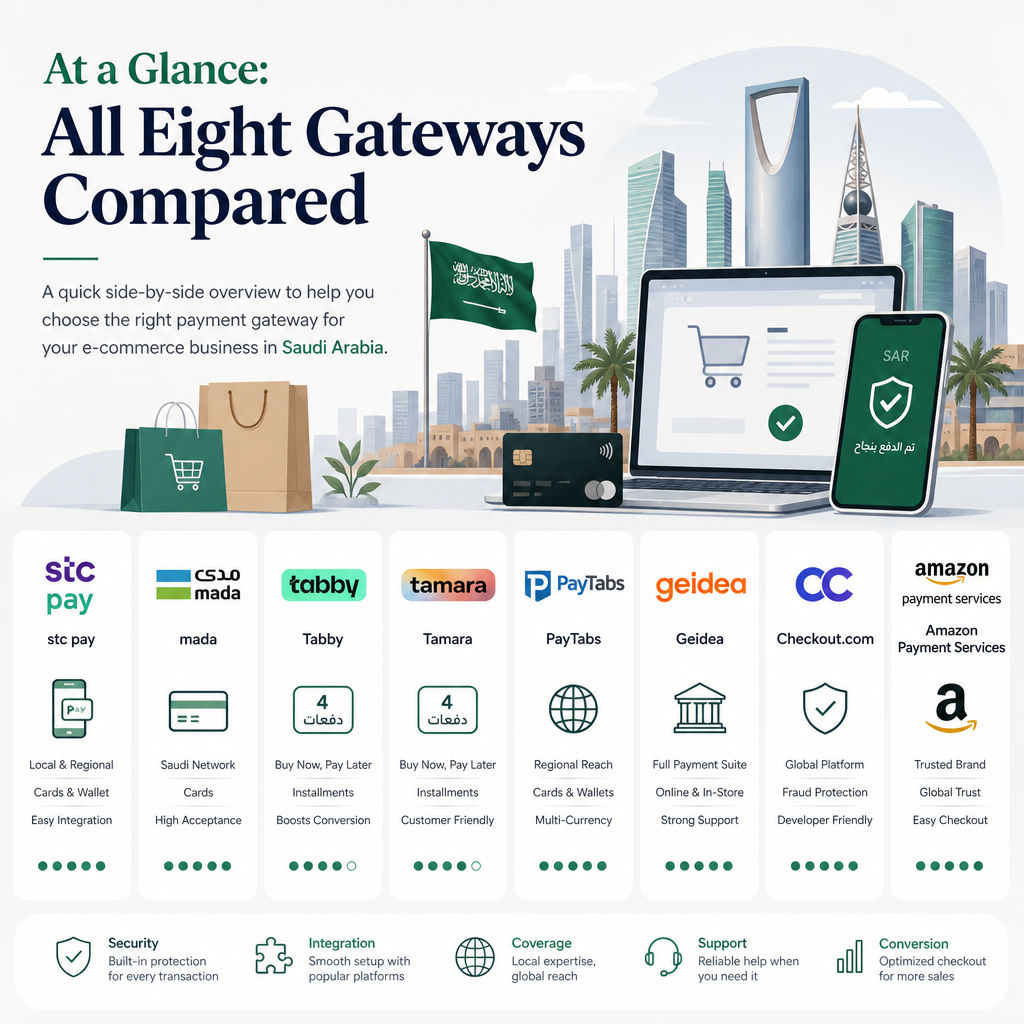
At a Glance: All Eight Gateways Compared
The table below summarises the key commercial and technical parameters for each gateway. MDR ranges are commonly quoted figures gathered from public provider documentation and merchant community discussions as of mid-2025 — always confirm the exact rate with the provider before signing, because pricing varies by business category, monthly volume, and negotiation.
| Gateway | Typical MDR (SAR transactions) | Settlement Window | Mada Support | SAMA Licensed / Registered | Key Platforms |
|---|---|---|---|---|---|
| HyperPay | 1.75% – 2.75% | T+1 to T+2 | Yes | Yes (Payment Facilitator) | Shopify, WooCommerce, Magento, Custom API |
| PayTabs | 1.85% – 2.90% | T+1 to T+3 | Yes | Yes (Authorised) | Shopify, WooCommerce, Magento, OpenCart |
| Checkout.com | Custom (typically 1.5% – 2.5% for mid-market) | T+2 to T+3 | Yes | Yes (Global licence, KSA entity) | Custom API, Shopify (via plugin), Magento |
| Tabby | Merchant fee 4% – 6% (BNPL; no interest to buyer) | T+1 to T+2 after instalment collected | Underlying card network | Regulated by SAMA (BNPL framework) | Shopify, WooCommerce, Magento, Salesforce |
| Tamara | Merchant fee 4% – 7% (BNPL; no interest to buyer) | T+1 to T+2 after instalment collected | Underlying card network | Regulated by SAMA (BNPL framework) | Shopify, WooCommerce, Magento, Custom API |
| Apple Pay (via gateway) | Gateway MDR applies; no Apple surcharge | Follows gateway | Yes (Mada on Apple Pay) | Passes through licensed gateway | Shopify Payments (not in KSA), via HyperPay/PayTabs/Checkout.com |
| STC Pay | ~1.5% – 2.5% (wallet-to-merchant) | T+1 | N/A (wallet funding) | Yes (SAMA e-money licence) | Custom API, select Shopify plugins |
| Mada (direct integration) | Typically 1.0% – 1.75% | T+1 | Native | Saudi Payments regulated | Via certified acquirer or gateway |
MDR = Merchant Discount Rate. Figures are indicative reference ranges; confirm with each provider for your specific business type and volume tier.
Why Payment Gateway Choice Defines Your KSA Conversion Rate
Saudi shoppers abandon carts for the same reasons shoppers everywhere do: the checkout is slow, their preferred payment method is missing, or they do not trust the page they are on. In Saudi Arabia, three payment methods dominate consumer preference — Mada debit, credit cards (Visa/Mastercard), and digital wallets, chiefly Apple Pay and STC Pay. A gateway that misses even one of these three categories will cost you sales.
SAMA (the Saudi Central Bank) regulates all payment service providers operating in the Kingdom. Before onboarding any gateway, cross-reference the provider against SAMA’s Licensed Payment Services registry. An unlicensed intermediary can have its operations suspended, which freezes your merchant account and your settlements along with it.
The other critical factor is VAT compliance. Saudi Arabia applies 15% VAT on most goods and services, and your payment gateway’s settlement reports need to align cleanly with your VAT returns. Gateways that provide itemised, downloadable settlement files (HyperPay and PayTabs are strong here) reduce reconciliation overhead considerably.
Mada Payment Integration: The Non-Negotiable Foundation
Mada is not optional. It is the default payment instrument for the majority of Saudi consumers, particularly those who do not hold international credit cards. Saudi Payments reports over 40 million Mada cards in circulation, and the network processes the bulk of domestic point-of-sale and e-commerce transactions in the Kingdom.
To accept Mada online, you need a gateway or acquirer that holds Saudi Payments certification for Mada e-commerce. HyperPay, PayTabs, and Checkout.com all carry this certification. If you are building on Shopify, neither Shopify Payments nor Stripe (in its standard form) supports Mada in Saudi Arabia, so you must integrate a third-party gateway. WooCommerce and Magento stores connect to Mada through the certified gateway’s plugin.
Mada transactions typically carry a lower MDR than international card networks — often in the 1.0% to 1.75% range — which makes high-volume stores particularly eager to drive Mada adoption. Display the Mada logo prominently at checkout; Saudi consumers look for it as a trust signal before entering their card details.
HyperPay: The KSA-Native Powerhouse
HyperPay is the payment gateway most frequently recommended within the Saudi merchant community, and for good reason. The company is headquartered in Riyadh, holds a SAMA payment facilitator licence, and has built its product around the specific requirements of Arabic-language storefronts — including right-to-left checkout UI, Mada, Apple Pay, STC Pay, and SADAD (the national bill payment network).
Onboarding for a registered Saudi entity typically takes five to ten business days. HyperPay requires a commercial registration (CR) number, a VAT certificate, a IBAN bank account at a Saudi bank, and standard KYC documents. Settlement runs on a T+1 to T+2 cycle with funds landing in SAR directly, eliminating currency conversion risk for local businesses.
Refunds through HyperPay are initiated via the merchant dashboard and typically reach the cardholder within three to seven business days depending on the issuing bank. The gateway supports partial refunds natively, which is important for stores with variable-weight or subscription products.
For Shopify merchants, HyperPay offers a dedicated plugin available through the Shopify App Store. For WooCommerce and Magento, official extensions are available through HyperPay’s developer portal. The API is REST-based with sandbox access available immediately upon registration, so your development team can begin integration before full KYC approval completes.
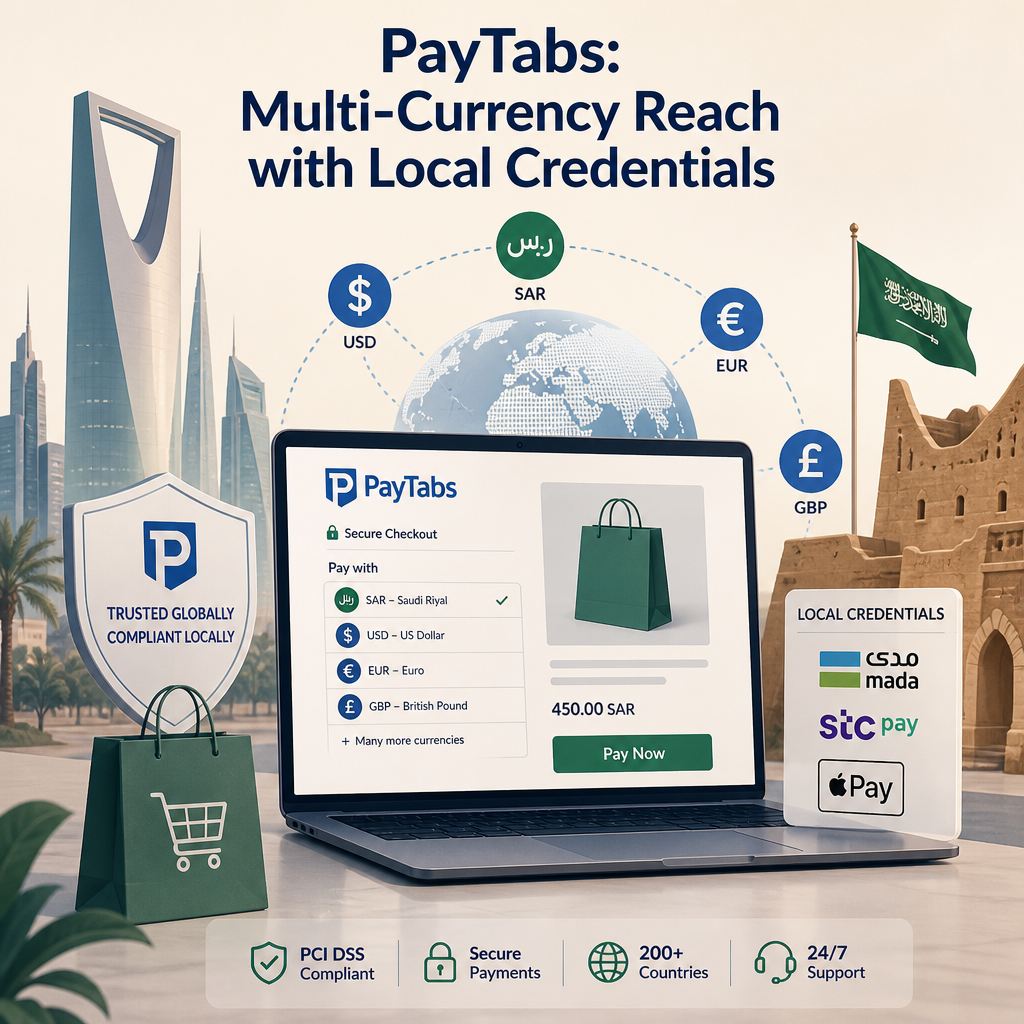
PayTabs: Multi-Currency Reach with Local Credentials
PayTabs is a Bahrain-headquartered gateway with a strong operational presence across the GCC, including Saudi Arabia. It is authorised by SAMA and supports Mada, Visa, Mastercard, Apple Pay, and a range of MENA-specific local payment methods. For merchants who sell across the Gulf — for example, a Riyadh-based fashion retailer also targeting UAE and Kuwait buyers — PayTabs offers multi-currency settlement in SAR, AED, KWD, and USD from a single account.
MDR at PayTabs typically falls between 1.85% and 2.90% for standard merchants. Volume-based pricing is available for stores processing above SAR 500,000 per month. Settlement is T+1 to T+3 depending on the currency and acquirer routing.
The PayTabs hosted payment page (HPP) is PCI-DSS Level 1 compliant and supports 3D Secure 2.0 (3DS2), which reduces friction on authenticated transactions while maintaining the liability shift for chargebacks. Onboarding takes approximately seven to fourteen business days for Saudi entities. PayTabs also provides a feature-rich merchant portal with transaction-level reporting, chargeback management tools, and a dedicated Arabic-language customer support team based in Riyadh.
Checkout.com: Enterprise-Grade Infrastructure
Checkout.com operates a global acquiring infrastructure with a dedicated legal entity and SAMA authorisation in Saudi Arabia. It is the gateway of choice for larger e-commerce operations — think regional retailers with annual GMV above SAR 10 million — because of its customisable pricing, advanced fraud tooling (Fraud Detection Pro), and unified dashboard that consolidates payment data across multiple countries.
Pricing at Checkout.com is typically negotiated on a custom basis. Mid-market merchants commonly see blended MDRs in the 1.5% to 2.5% range for Visa and Mastercard, with Mada rates available through its Saudi acquiring setup. Settlement is T+2 to T+3 for most currencies.
The Checkout.com API is among the most developer-friendly in the market — well-documented, with comprehensive webhook support, modular payment flows, and pre-built SDKs for iOS, Android, React, and Node. For Shopify, there is a Checkout.com plugin available; Magento merchants use the official extension from the Magento Marketplace. The platform’s 3DS2 support and network tokenisation capabilities are particularly valuable for reducing false declines on high-value orders, a common pain point for electronics and luxury goods merchants in Saudi Arabia.
Apple Pay in Saudi Arabia: Fast, Trusted, and Already in Your Customers’ Pockets
Apple Pay penetration in Saudi Arabia is among the highest in the world, driven by very high iPhone ownership rates across the Kingdom’s affluent urban consumer base. Shoppers in Riyadh and Jeddah frequently complete mobile checkouts with a single Face ID confirmation, making Apple Pay a measurable conversion booster for mobile-first stores.
Apple Pay does not charge merchants separately. You pay your gateway’s standard MDR, and Apple Pay is simply a tokenised payment method on top. To accept Apple Pay, your gateway must be Apple Pay-certified (HyperPay, PayTabs, and Checkout.com all are) and your domain must pass Apple’s domain verification process. On Shopify, Apple Pay activates automatically when you enable a compatible third-party payment provider under Settings > Payments.
One nuance specific to Saudi Arabia: Mada cards can be added to Apple Wallet and used for Apple Pay transactions. This means a customer paying with Apple Pay may actually be transacting on the Mada network, and the lower Mada MDR applies. Confirm this routing detail with your gateway to ensure accurate fee forecasting.
STC Pay: Capturing Saudi Wallet Users
STC Pay is the digital wallet arm of Saudi Telecom Company and holds a SAMA e-money licence. With tens of millions of registered users across Saudi Arabia, it functions as a peer-to-peer transfer service, bill payment tool, and increasingly a merchant payment method. For e-commerce stores targeting younger Saudi consumers who prefer not to share card details online, STC Pay provides a familiar, trusted alternative.
Integration for merchants is via API. STC Pay provides an e-commerce payment kit, and select Shopify plugins support STC Pay as a payment option. The typical MDR for merchant transactions sits between 1.5% and 2.5%, with settlement on a T+1 basis directly to a Saudi bank account.
STC Pay is particularly strong for high-frequency, lower-ticket transactions — food delivery, digital services, and subscription billing. For fashion or electronics with higher average order values, pair it with a card gateway rather than relying on it exclusively.
Tabby and Tamara: Buy Now, Pay Later for Saudi Shoppers
Buy Now, Pay Later (BNPL) has reshaped checkout behaviour across Saudi Arabia. Both Tabby and Tamara are SAMA-regulated under the Kingdom’s BNPL framework, which requires consumer credit assessment, transparency in instalment terms, and defined dispute resolution processes. For merchants, BNPL increases average order value — often by 20% to 40% in fashion and electronics categories — because customers can split a SAR 800 purchase into four SAR 200 payments without interest charges to themselves.
Tabby
Tabby allows shoppers to split purchases into four interest-free instalments or pay in 14 days with no fees. The merchant pays a fee per transaction, typically in the 4% to 6% range, which is higher than a standard card MDR but offset by the lift in conversion and basket size. Tabby takes on the credit risk entirely, so merchants receive 100% of the order value (minus the fee) regardless of whether the shopper completes all instalments.
Tabby’s Shopify plugin is available directly from the Shopify App Store. WooCommerce and Magento merchants integrate via plugin or API. Onboarding requires a verified Saudi commercial registration and bank account; approval typically takes three to five business days. Refunds on Tabby orders are processed through the merchant dashboard, and Tabby automatically adjusts the remaining instalment schedule for the shopper.
Settlement from Tabby runs on a T+1 to T+2 cycle after each instalment is collected from the consumer. Tabby also provides promotional placement within its consumer app, giving listed merchants exposure to Tabby’s active Saudi user base.
Tamara
Tamara is the Riyadh-headquartered BNPL provider and Tabby’s primary competitor. It offers three-instalment (split into 30-day intervals) and monthly instalment plans, with merchant fees typically in the 4% to 7% range depending on the product category and volume tier. Like Tabby, Tamara bears all consumer credit risk and settles directly with the merchant.
Tamara launched a Shopify plugin (available on the Shopify App Store under “Tamara”) and supports WooCommerce via an official plugin in the WordPress plugin directory. Magento merchants use Tamara’s custom module. Onboarding requires a Saudi CR, VAT certificate, and bank account, with an average approval timeline of three to seven business days.
Tamara’s merchant dashboard provides granular reporting on BNPL order performance, including conversion uplift data segmented by product category. Its consumer app has strong penetration in Saudi Arabia and Bahrain, and Tamara actively promotes partner merchants through in-app discovery features.
Tabby vs. Tamara: A Direct Comparison
| Feature | Tabby | Tamara |
|---|---|---|
| Instalment Options | 4x interest-free or pay in 14 days | 3x monthly or longer-term plans |
| Merchant Fee Range | 4% – 6% | 4% – 7% |
| Settlement | T+1 to T+2 per instalment collected | T+1 to T+2 per instalment collected |
| Credit Risk | Borne by Tabby | Borne by Tamara |
| Shopify Plugin | Yes (App Store) | Yes (App Store) |
| WooCommerce Plugin | Yes (official) | Yes (official) |
| Magento Support | Yes (API/plugin) | Yes (custom module) |
| SAMA Regulated | Yes | Yes |
| Consumer App Marketplace | Yes (strong KSA presence) | Yes (strong KSA and Bahrain) |
| Onboarding Time | 3 – 5 business days | 3 – 7 business days |
| Refund Handling | Dashboard-initiated; instalment adjusted automatically | Dashboard-initiated; instalment adjusted automatically |
The practical difference between Tabby and Tamara for most merchants is marginal. Many Saudi stores run both simultaneously to let the shopper choose. If you can only start with one, base the decision on which gateway your primary product category performs better in — Tabby skews strong in fashion and beauty; Tamara has deep penetration in electronics and home goods.
Shopify in Saudi Arabia: Your Gateway Options
Shopify is the most widely used e-commerce platform for new and growing Saudi merchants, and understanding exactly how payment gateways connect to a Shopify store in Saudi Arabia saves you significant setup time. Shopify Payments and Stripe are not available in Saudi Arabia as of mid-2025, which means every Shopify merchant in the Kingdom needs a third-party payment provider.
Here is the practical setup path for each supported gateway on Shopify:
- HyperPay: Install the “HyperPay” app from the Shopify App Store. After installing, enter your HyperPay merchant credentials (Entity ID and access token from the HyperPay dashboard). Enable Mada, Apple Pay, and STC Pay as separate payment methods within the app settings. Shopify’s additional transaction fee (0.5% to 2% depending on your Shopify plan) applies on top of HyperPay’s MDR unless you are on Shopify Plus.
- PayTabs: Search “PayTabs” in the Shopify App Store. The PayTabs app supports hosted payment page and direct API integration modes. Configure your PayTabs Profile ID and server key from the PayTabs merchant portal. Enable 3DS2 within the app for maximum fraud protection.
- Checkout.com: The Checkout.com Shopify plugin is available in the App Store. You will need your Checkout.com public and secret API keys from the Hub dashboard. The plugin supports Apple Pay natively once domain verification is complete.
- Tabby: Install “Tabby” from the Shopify App Store. Tabby integrates as a separate payment method at checkout, displayed alongside your card gateway. No additional Shopify transaction fee applies to Tabby payments on standard plans — confirm this with Shopify support for your plan tier.
- Tamara: Install “Tamara” from the Shopify App Store. Configuration mirrors Tabby: enter your Tamara merchant public and private keys and select which payment plans to offer.
If you need help configuring multiple payment gateways on a single Shopify store — for example, HyperPay for card payments alongside both Tabby and Tamara for BNPL — the Shopify development team at RedRock handles these integrations end-to-end, including sandbox testing, go-live support, and ongoing reconciliation setup.
Security, PCI-DSS, and Fraud Protection
Every gateway in this guide operates at PCI-DSS Level 1, the highest standard for cardholder data security. This means that when you use a hosted payment page or tokenised integration, your server never stores raw card numbers, and your PCI compliance scope is dramatically reduced compared to a self-hosted card form.
3D Secure 2.0 (3DS2) is the authentication standard used across Saudi Arabia’s card networks. Under 3DS2, low-risk transactions are authenticated silently (frictionless flow), while high-risk or high-value transactions trigger a biometric or OTP verification. Liability for fraudulent chargebacks shifts to the card issuer once 3DS2 authentication succeeds, which protects merchants in high-average-order-value categories.
HyperPay and PayTabs both include built-in rule-based fraud engines at no additional cost on standard plans. Checkout.com’s Fraud Detection Pro module provides machine-learning-based risk scoring and is worth enabling for stores processing above SAR 200,000 per month. BNPL providers (Tabby and Tamara) perform their own consumer credit checks before approving each BNPL transaction, which also filters out a category of fraudulent orders.
How to Choose the Right Payment Gateway for Your KSA Store
Use this checklist before signing any merchant agreement:
- Mada support confirmed: Verify the gateway holds Saudi Payments Mada e-commerce certification.
- SAMA licence verified: Check the provider on SAMA’s official Licensed Payment Services registry before signing.
- Platform compatibility: Confirm there is an official plugin for your platform (Shopify, WooCommerce, or Magento) with recent update history.
- MDR and fee structure in writing: Get the full fee schedule — MDR by card type, monthly platform fee, chargeback fee, and refund fee — in a written merchant agreement before going live.
- Settlement currency and timeline: Confirm funds arrive in SAR in your Saudi bank account on the timeline quoted (T+1, T+2, or T+3).
- Refund policy: Test a refund in the sandbox environment and confirm the consumer-facing timeline matches your store’s stated return policy.
- 3DS2 enabled by default: Any gateway that does not support 3DS2 in Saudi Arabia exposes you to unnecessary chargeback liability.
- Arabic checkout UI available: Saudi consumers expect both Arabic and English at checkout; confirm RTL support in the gateway’s hosted page.
- BNPL layer considered: If your average order value exceeds SAR 300, add at least one BNPL option (Tabby or Tamara) alongside your card gateway.
- Support availability: Confirm the gateway provides Arabic-language support during Saudi business hours (Sunday to Thursday).
For a deeper look at how payment gateway selection fits into your overall checkout strategy, see the guide on optimising your e-commerce checkout flow for Saudi markets.
Fees: What You Will Actually Pay
The MDR is only one component of gateway cost. A full cost comparison for a SAR 1,000 transaction across the main gateways (using the midpoint of indicative MDR ranges) looks like this:
- HyperPay (Mada, ~1.5% MDR): SAR 15.00 fee, SAR 985.00 net to merchant.
- HyperPay (Visa/MC, ~2.25% MDR): SAR 22.50 fee, SAR 977.50 net to merchant.
- PayTabs (Visa/MC, ~2.40% MDR): SAR 24.00 fee, SAR 976.00 net to merchant.
- Checkout.com (Visa/MC, ~2.00% MDR negotiated): SAR 20.00 fee, SAR 980.00 net to merchant.
- Tabby (~5% merchant fee): SAR 50.00 fee, SAR 950.00 net to merchant — offset by higher conversion and larger basket.
- Tamara (~5.5% merchant fee): SAR 55.00 fee, SAR 945.00 net to merchant — with the same BNPL uplift dynamic.
Remember that Shopify merchants on Basic or Shopify plans pay an additional 2% or 1% transaction fee respectively unless using Shopify Plus. Factor this into your total cost per transaction, and if you are processing significant volume, model whether upgrading your Shopify plan pays for itself through fee savings.
Integration Services: Getting It Done Without the Headaches
Configuring a single gateway is straightforward for a developer. Configuring three or four gateways simultaneously — card payment, Apple Pay, STC Pay, Tabby, and Tamara — and ensuring they co-exist correctly, display the right logos in the right order, and pass the correct transaction metadata to your accounting system is a different task entirely.
RedRock’s e-commerce development team specialises in payment gateway integration for Shopify, WooCommerce, and Magento stores across Saudi Arabia and the wider GCC. From initial gateway selection through to sandbox testing, go-live, and post-launch reconciliation support, the team handles the technical complexity so you can focus on running the business. Projects typically complete in five to fifteen business days depending on stack complexity.
If you are building a new store from scratch or migrating from one platform to another, embedding the correct payment stack from day one is far less costly than retrofitting it later. The e-commerce development services page outlines how RedRock approaches end-to-end store builds for the Saudi market.
Key Takeaways
- The best payment gateways for e-commerce in Saudi Arabia all share one trait: native Mada support. Start there and build outward.
- HyperPay is the default first choice for most Saudi merchants — local presence, fast settlement, full Arabic support, and broad platform coverage.
- PayTabs suits merchants who need multi-currency GCC reach from a single account.
- Checkout.com is the right fit for larger operations that need custom pricing, advanced fraud tools, and enterprise-grade API access.
- Apple Pay and STC Pay are not gateways on their own — they layer on top of your primary card gateway and should be enabled from day one given their adoption rates in Saudi Arabia.
- Add at least one BNPL option (Tabby or Tamara, or both) if your average order value is above SAR 300.
- Verify every provider on SAMA’s registry before signing. PCI-DSS Level 1 and 3DS2 are non-negotiable security baselines.
- Shopify merchants in Saudi Arabia must use a third-party payment provider — Shopify Payments is not available in KSA as of mid-2025.
Conclusion
Saudi Arabia’s e-commerce growth creates real opportunity, but that opportunity only converts into revenue if your checkout works flawlessly for Saudi shoppers. Choosing the best payment gateways for e-commerce in Saudi Arabia means covering Mada, supporting digital wallets like Apple Pay and STC Pay, offering BNPL through Tabby or Tamara for higher-value purchases, and ensuring every provider you work with holds a valid SAMA licence.
The gateway landscape in the Kingdom is mature enough that you have genuinely strong options at every business size — from a startup fashion brand in Jeddah to a multi-category retailer processing tens of millions in annual GMV. The difference between a good outcome and a poor one often comes down to implementation quality: clean plugin configuration, thorough sandbox testing, and properly structured settlement reports.
If you want a development team that knows the KSA payment ecosystem inside out, get in touch with RedRock to discuss your store’s payment integration requirements. Whether you are launching on Shopify, migrating a WooCommerce store, or rebuilding on Magento, the right payment stack is one of the best investments you can make before your first marketing campaign goes live.