



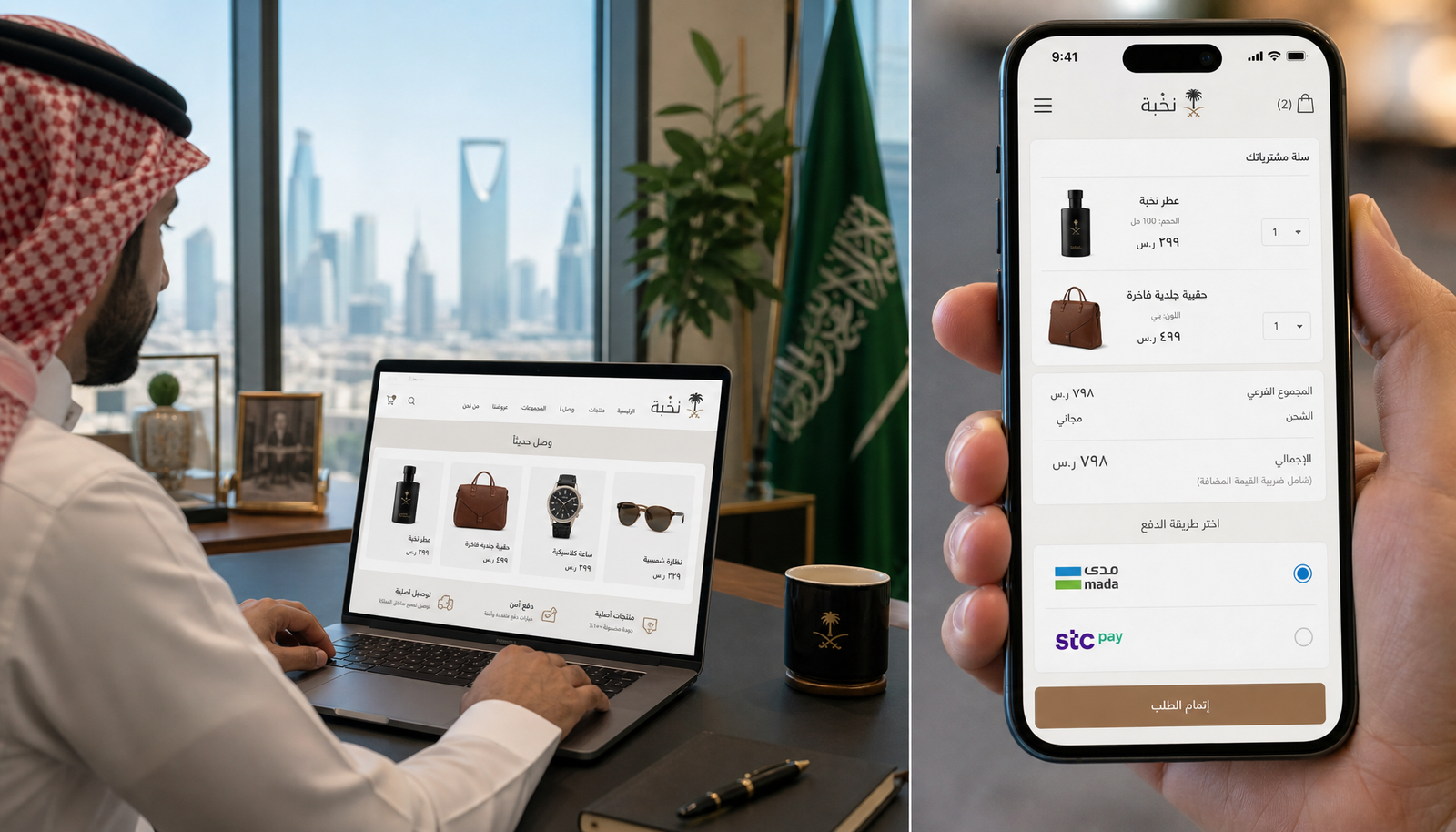
Saudi Arabia’s digital economy is growing at a pace most markets only read about in forecasts. The Kingdom’s e-commerce sector was valued at approximately USD 222.9 billion in 2024 and is projected to reach USD 708.7 billion by 2033, powered by a smartphone penetration rate that sits at a near-universal 99%. Every Saudi entrepreneur building an online business faces the same foundational decision: does your brand need an e-commerce website or app for Saudi customers, or both? The answer has real cost, reach, and revenue consequences, and this guide gives you a clear, scenario-specific framework to make it.
Whether you run a fashion boutique in Riyadh, a grocery startup in Jeddah, or a B2B supply business in Dammam, the build-vs-platform decision is not interchangeable across those three contexts. This article compares responsive e-commerce websites, progressive web apps (PWAs), and native or cross-platform mobile apps across every dimension that matters: cost in SAR, customer reach, push notifications, loyalty mechanics, checkout performance, payment stacks, and long-term maintenance. By the end, you will have a decision table, three concrete business scenarios with explicit recommendations, and a payment cost-stack callout covering Mada, STC Pay, Tamara, Apple commissions, and Saudi 15% VAT on digital services.
The Saudi Mobile Commerce Reality in 2025
Mobile commerce Saudi Arabia is not an emerging channel — it is the primary channel. Statista’s Saudi Arabia e-commerce market overview consistently shows that more than 70% of Saudi online purchases are completed on a mobile device. That figure is higher than the global average and higher than most GCC peers.
Saudi consumers are early adopters of super-apps and loyalty programs. Platforms such as Noon, Tamimi Markets, Jarir Bookstore, and Nana have invested heavily in native apps precisely because their repeat-purchase frequency justifies the investment. But the app stores are also littered with abandoned Saudi retail apps that never broke 10,000 downloads. Understanding why some apps win and others disappear is the core skill this guide builds.
Three technical formats compete for your budget and attention:
- Responsive e-commerce website – a single codebase that adapts to any screen size, hosted on a platform such as Shopify, WooCommerce, or Magento.
- Progressive web app (PWA) – a website that installs on a home screen, works partially offline, and can send push notifications without an app store listing.
- Native or cross-platform mobile app – a dedicated app installed from the Apple App Store or Google Play, built in Swift/Kotlin or with frameworks like React Native or Flutter.

Cost Comparison: What Does Each Option Actually Cost in SAR?
Cost is the first filter for most Saudi SMEs. Here is a realistic range for each format, assuming a mid-complexity online store with Arabic and English support, Saudi payment gateway integration, and a product catalogue of 200-2,000 SKUs.
Responsive E-commerce Website
- Shopify Basic to Advanced plans: SAR 150-750 per month (billed in USD, converted at current rates; Shopify charges 15% VAT on Saudi subscriptions).
- Custom WooCommerce or Magento build: SAR 15,000-80,000 one-time development cost, plus SAR 500-2,000 per month in hosting and maintenance.
- Domain + SSL: SAR 100-400 per year.
- Ongoing SEO and content: SAR 2,000-8,000 per month if outsourced.
A responsive website is the lowest barrier to entry. A Riyadh-based abaya retailer can launch on Shopify in two weeks, integrate Mada and STC Pay through Moyasar or Tap Payments, and start selling before spending a single riyal on app development. This is the correct starting point for most businesses under three years old.
Progressive Web App (PWA)
- Added to an existing Shopify or Magento site: SAR 8,000-25,000 one-time build.
- Standalone PWA on a custom stack: SAR 30,000-90,000.
- Maintenance: SAR 800-2,500 per month.
PWAs occupy a smart middle ground. Landmark Group’s regional digital teams have used PWA architecture to deliver app-like speed and home-screen installation without requiring customers to visit an app store. For Saudi businesses that want push notifications and offline browsing without the cost of a native app, a PWA built on top of an existing Shopify store is frequently the best next step.
Native or Cross-Platform Mobile App
- Cross-platform (React Native / Flutter): SAR 75,000-200,000 for a well-scoped e-commerce app.
- Fully native (separate iOS and Android codebases): SAR 150,000-400,000 and up.
- Annual maintenance and update costs: 15-20% of build cost per year.
- Apple App Store fee: USD 99/year (approx. SAR 371/year).
- Google Play fee: USD 25 one-time (approx. SAR 94).
These figures explain why app development is a commitment, not an experiment. A Jeddah grocery startup spending SAR 150,000 on a native app before proving product-market fit is taking on a significant risk. The same budget deployed into paid search, a high-performance PWA, and inventory would almost certainly generate faster returns in year one.
Reach: Who Can Actually Find and Use Your Store?
A responsive website is discoverable through Google and Bing searches, social media links, WhatsApp shares, and QR codes. A new customer in Khobar who searches “online flower delivery near me” in Arabic can land on your website within seconds of it ranking. A native app requires that same customer to visit the App Store, search for your brand by name, read reviews, wait for a download, and then open it. That friction is the single biggest reach barrier apps face.
Google’s mobile app marketing research shows that roughly 25% of downloaded apps are abandoned after a single use. The install-to-active-user conversion rate for most retail apps outside the top 50 brands sits below 30%. This is not a Saudi-specific problem — it is a universal app economics problem that hits harder when your brand is not yet a household name.
Verdict: for reaching new customers who do not yet know your brand, a well-optimized responsive website or PWA wins decisively over a native app. Apps earn their place when you are converting existing customers into higher-frequency buyers, not when you are trying to acquire cold traffic.
Push Notifications, Loyalty, and Retention
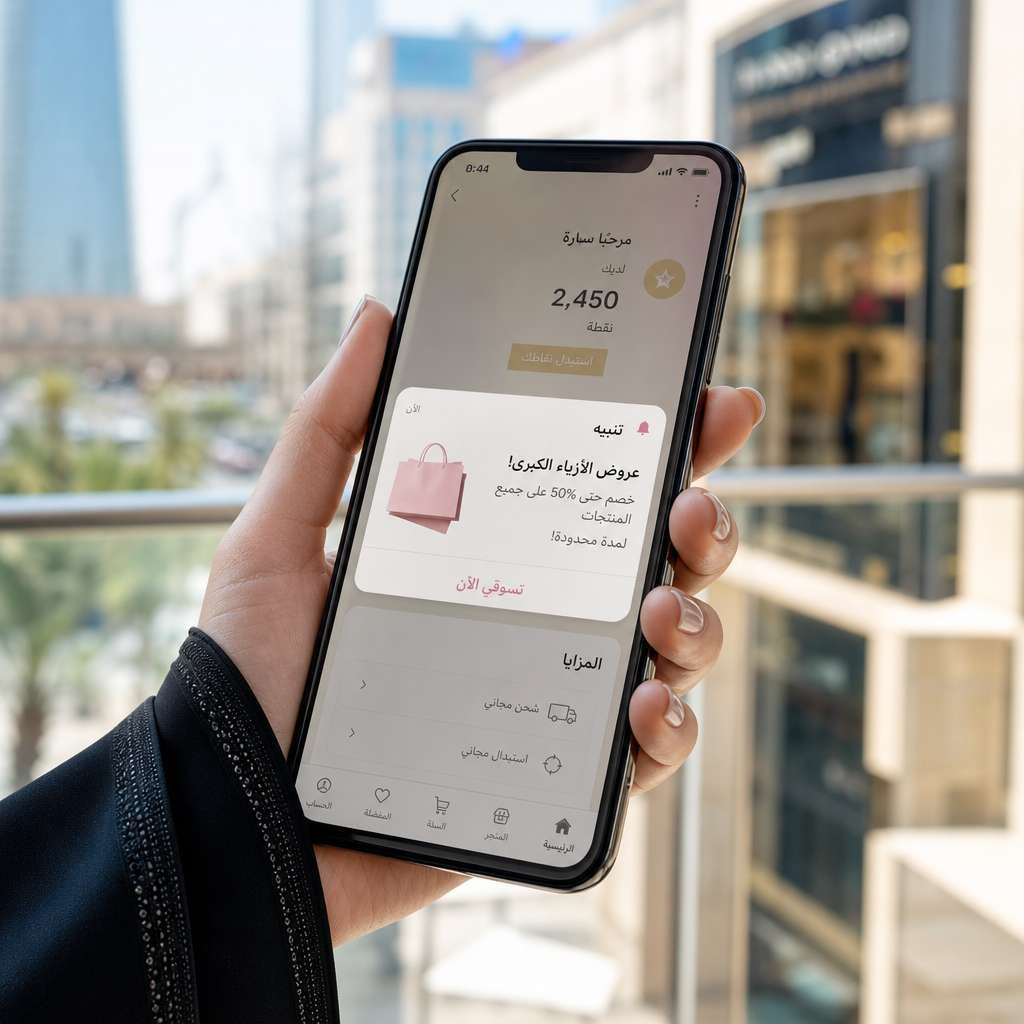
This is where native apps genuinely outperform websites. A well-timed push notification can lift abandoned cart recovery rates by 15-25%, and opt-in rates for push on native apps consistently outperform browser-based push notifications, which Safari and Chrome handle inconsistently on iOS.
For a Saudi fashion retailer running a mid-season sale during the Riyadh Season, the ability to send a localized Arabic push notification at 8 PM — exactly when Saudi consumers are most active online — is a real competitive advantage. Noon and Namshi have built significant portions of their repeat-purchase revenue on this mechanic.
Push Notification Comparison
- Native app push: highest opt-in rates (30-60% of active users), most reliable delivery, full rich-media support (images, deep links into specific product pages).
- PWA push: works on Android, limited on iOS (Apple introduced PWA push support in iOS 16.4, but adoption and reliability still lag behind native). Opt-in rates typically 10-25%.
- Email / SMS / WhatsApp: available to all website customers regardless of platform. WhatsApp Business API has particularly high open rates in Saudi Arabia, where WhatsApp usage is near-universal.
Loyalty programs also perform differently across formats. A points-based loyalty system embedded in a native app (think Starbucks Saudi Arabia or Jarir Bookstore’s app) benefits from biometric login, one-tap redemption, and gamification features that feel native to the device. A website-based loyalty program is entirely viable — platforms like Smile.io and LoyaltyLion integrate with Shopify and WooCommerce — but the daily habit-forming quality of an app icon on the home screen is measurably stronger for high-frequency categories.
Verdict: if your customers buy from you more than once a month and loyalty retention is central to your business model, the push notification and loyalty advantages of a native app are worth the investment. If purchase frequency is quarterly or lower, WhatsApp and email flows built on your website will outperform a rarely-opened app.
Mobile Checkout Performance and the Saudi Payment Stack
Checkout abandonment is the most expensive technical problem in Saudi e-commerce. Any friction — a slow page, a missing payment method, a confusing Arabic RTL layout, or a 3DS authentication popup that breaks on an older Android device — costs you the sale.
Saudi Payment Cost-Stack Callout
Every Saudi e-commerce business needs to understand the full cost of taking a payment. Here is a realistic breakdown of what you pay per transaction, using a SAR 200 order as an example:
- Mada (local debit network): gateway fees typically 1.5-1.75% + SAR 0.50-1.00 fixed per transaction. Mada is mandatory for reaching Saudi consumers who do not hold credit cards — a significant portion of younger and lower-income shoppers.
- STC Pay: approximately 1.75-2.5% per transaction depending on your gateway provider (Moyasar, Tap Payments, HyperPay). STC Pay has over 13 million registered users in Saudi Arabia and is a high-conversion payment method for mobile-first shoppers.
- Tamara (Buy Now Pay Later): merchant fee of approximately 3-6% per transaction. High average order value uplift (often 20-40%) makes this cost acceptable for fashion, electronics, and furniture categories. Tamara is now one of the most-requested payment options by Saudi consumers under 35.
- Credit/debit card (Visa/Mastercard): 2.0-2.9% through most Saudi gateways.
- Apple Pay (on iOS native app or Safari): Apple takes a 0.15% fee from the issuing bank, which is passed through in your effective gateway rate. On a native iOS app, Apple Pay offers one-tap checkout with biometric authentication — the highest-converting payment UX available on mobile. However, Apple’s in-app purchase policy (30% commission on digital goods and subscriptions) does not apply to physical goods e-commerce apps, so a clothing or grocery app is not affected.
- Saudi 15% VAT on digital services: platforms and SaaS tools (Shopify subscriptions, app development tools, cloud hosting, payment gateway software fees) are subject to 15% VAT under Saudi Arabia’s rules for electronic services. Your gateway transaction fees on physical goods sales attract VAT at 15% on the service fee portion, not on the transaction value itself. Always verify your VAT obligations with a Saudi-registered accountant or the Zakat, Tax and Customs Authority (ZATCA).
On a SAR 200 order processed via STC Pay (2.25%) + Tamara (4%), your combined payment cost is SAR 4.50 to SAR 8.00 per order before VAT on fees. Plan this into your margins before choosing between a website (where you control the checkout entirely) and a native app (where you cannot replace Apple’s native payment sheet on iOS).
Checkout UX: Website vs. PWA vs. Native App
- Responsive website: Full control over the checkout flow. Shopify’s checkout is already highly optimized and supports Arabic. WooCommerce with a custom RTL theme performs well when configured correctly. Page speed is the primary variable — target under 3 seconds on a 4G connection.
- PWA: Inherits the website’s checkout but adds offline caching for product browsing. Checkout still requires a live connection. Performance gains from service workers reduce perceived load times.
- Native app: Best-in-class checkout UX. Biometric authentication (Face ID, fingerprint), saved payment methods, Apple Pay and Google Pay one-tap, and no browser address bar distractions. Studies from Contentsquare’s Digital Experience Benchmark consistently show native app conversion rates 3-5x higher than mobile web for the same brand. The caveat: those users already downloaded and kept the app, meaning you are measuring a self-selected high-intent audience.
Maintenance, Updates, and Long-Term Technical Debt
A Shopify website updates automatically. Security patches, payment gateway compatibility, new Mada or STC Pay API versions — Shopify handles most of this infrastructure. Your team updates products, runs discounts, and writes content. The maintenance burden is low.
A native app requires updates every time iOS or Android releases a major OS version. Apple’s App Store review process averages 24-48 hours for routine updates and can take 7-14 days for significant feature changes. If a Saudi payment gateway updates its SDK and your app does not ship a compatible version within the required window, your checkout breaks. That is an operational risk that small teams often underestimate.
Cross-platform frameworks like React Native and Flutter reduce — but do not eliminate — this dual-platform maintenance burden. Expect to allocate 15-20% of your initial build cost annually for ongoing maintenance, bug fixes, and OS compatibility work. For a SAR 150,000 app build, that is SAR 22,500-30,000 per year before any new feature development.
A WooCommerce or Magento website sits between these two extremes. Plugins need regular updates, PHP version compatibility is an ongoing concern, and a neglected WooCommerce site accumulates technical debt. Managed hosting providers such as Kinsta or WP Engine reduce this burden significantly for Saudi businesses that choose the WordPress route.
When Does a Mobile App Become Worthwhile? The Decision Framework
An app earns its SAR 150,000-plus investment when at least three of the following five conditions are true:
- Purchase frequency is weekly or higher – grocery, coffee, pharmacy, meal kits.
- Your active customer base exceeds 10,000 users – enough to justify push notification infrastructure and make loyalty mechanics financially meaningful.
- You have a loyalty or subscription model – points, tiers, subscriptions, and refill reminders require the persistent session management that apps handle best.
- Your category is experience-driven – AR try-on for eyewear, 3D room visualization for furniture (IKEA’s Saudi app uses this), or real-time order tracking for food delivery all benefit from native device APIs that websites cannot match.
- You are investing in app marketing to drive installs – an app with no acquisition budget will not sustain itself. Budget SAR 15,000-40,000 per month in Apple Search Ads and Google UAC campaigns to maintain healthy install volumes.
If fewer than three of these apply, a high-performance PWA or an optimized Shopify/WooCommerce store will deliver better ROI. Revisit the app decision in 12-18 months when your customer data is richer.
Decision Table: Which Format Fits Which Business?
- New online store, under 2 years old, less than 5,000 customers – Responsive website (Shopify or WooCommerce). Focus on SEO, WhatsApp marketing, and Mada/STC Pay integration.
- Growing brand, 5,000-50,000 customers, moderate repeat purchase – Add a PWA layer to your existing site. Enable push notifications, improve mobile checkout speed, and invest in email and WhatsApp automation.
- Established brand, 50,000+ active customers, high purchase frequency – Native or cross-platform app (React Native or Flutter) alongside the website. Run both in parallel; the website handles acquisition, the app handles retention.
- B2B/wholesale with large order values and account-based buying – Custom web portal (Magento B2B or Shopify Plus) with a buyer-facing PWA. Native apps rarely justify their cost in B2B Saudi contexts where orders are placed by procurement teams on desktops.
- Hyperlocal delivery (grocery, pharmacy, restaurant) – Native app from day one if you have the funding, because real-time order tracking and push notifications are table-stakes in this category. Otherwise, partner with an existing app platform (Nana, Jahez, HungerStation) while you build your own.
Three Saudi Business Scenarios: Explicit Recommendations
Scenario 1: Riyadh Fashion Boutique
A Riyadh-based abaya and modest fashion retailer with an Instagram following of 80,000, a current monthly online revenue of SAR 120,000, and roughly 3,500 unique buyers per year. Purchase frequency averages 2.5 times per year per customer. This business should build on Shopify Advanced with a high-quality Arabic RTL theme, integrate Tamara for installment payments (average order value in fashion is high enough to make the 4-5% Tamara fee worthwhile), and add a custom Arabic Shopify theme for optimal RTL presentation. A native app is not justified yet — the purchase frequency of 2.5 times per year means most customers will delete an app between purchases. Instead, invest in WhatsApp Business API flows for cart abandonment and post-purchase nurturing, and consider a PWA upgrade in 18 months when the customer base exceeds 8,000 active buyers.
Scenario 2: Jeddah Grocery Startup
A Jeddah-based online grocery startup targeting the 25-40 demographic in Al-Rawabi and Al-Salamah districts, with delivery within 90 minutes. Target purchase frequency: 3-4 times per month per household. This business needs a native app from the outset, even if it stretches the initial budget. Grocery is a category where the app icon on the home screen drives habitual weekly ordering. A responsive website alone will not compete with Nana or Carrefour’s app in terms of repeat purchase conversion. Build on React Native to share code across iOS and Android, integrate Mada as the primary payment method (many Saudi grocery shoppers are Mada-only), add Apple Pay and STC Pay, and launch a simple points loyalty scheme from month one. Budget SAR 30,000-50,000 for the first six months of Apple Search Ads and Google UAC to drive installs in the target districts.
Scenario 3: Dammam B2B Industrial Supplier
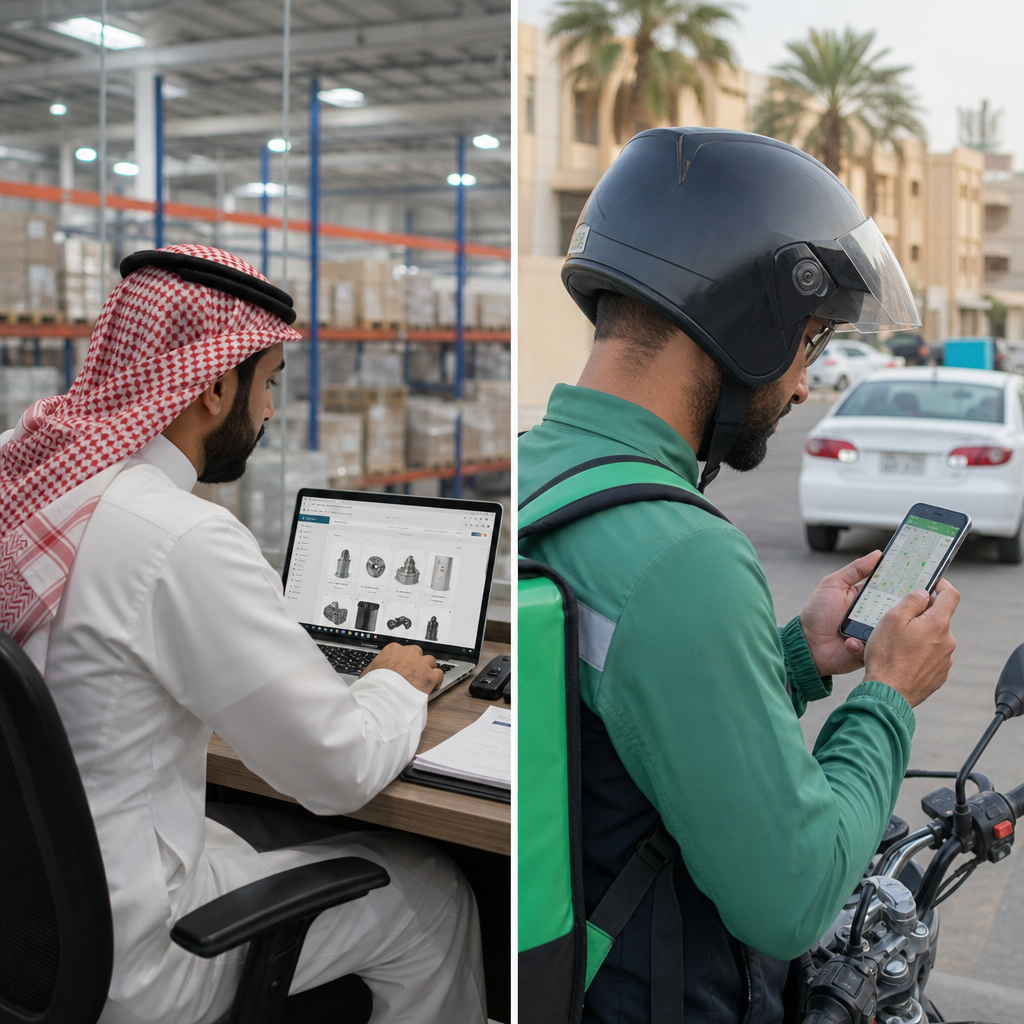
A Dammam-based supplier of safety equipment and industrial consumables selling to oil, gas, and construction companies across the Eastern Province. Average order value: SAR 8,000-25,000. Buyers are procurement managers using corporate laptops. This business should build a Magento 2 or Shopify Plus B2B web portal with account-based pricing, purchase order (PO) payment support, and Arabic-language product documentation. A native mobile app would be used by almost no one in this procurement workflow. The budget saved on app development (SAR 150,000+) is better spent on a Magento B2B implementation with customer-specific catalogues, credit terms, and integration with a Saudi ERP system such as Odoo or SAP. A PWA enhancement for the web portal can come later if field technicians need offline catalogue access on-site.
Performance: Speed and Core Web Vitals in the Saudi Context
Saudi Arabia has excellent 5G coverage in Riyadh, Jeddah, and Dammam, but rural areas and some industrial zones still rely on 4G with variable speeds. Your e-commerce website must load in under 3 seconds on a mid-range Android device on a 4G connection. Google’s Core Web Vitals — Largest Contentful Paint (LCP), Interaction to Next Paint (INP), and Cumulative Layout Shift (CLS) — directly influence your search ranking on Google.com.sa.
A poorly optimized WooCommerce site with uncompressed Arabic font files, unoptimized product images, and a slow shared hosting plan will rank below a well-configured competitor’s Shopify store, regardless of which has the better products. Use Cloudflare’s CDN (free tier covers most SME needs) with edge nodes in the Middle East to reduce latency for Saudi users. Compress images to WebP format. Defer non-critical JavaScript. These are not optional nice-to-haves for a Saudi e-commerce platform — they are ranking factors and conversion rate factors simultaneously.
Key Takeaways
- Saudi Arabia’s 99% smartphone penetration and USD 708.7 billion e-commerce growth trajectory make mobile performance non-negotiable for every online business in the Kingdom.
- The right e-commerce website or app for Saudi businesses depends on purchase frequency, customer base size, loyalty model, and available budget — not on what competitors are doing.
- Responsive websites win on reach and SEO. Native apps win on retention, push notifications, and checkout conversion for high-frequency categories. PWAs occupy a cost-effective middle ground.
- The full Saudi payment stack — Mada, STC Pay, Tamara, Apple Pay, and 15% VAT on digital service fees — must be budgeted into your platform decision from day one.
- Most Saudi SMEs should start with a high-performance responsive website, add a PWA layer as they grow, and evaluate a native app only when purchase frequency and customer base size justify the SAR 150,000+ investment.
- B2B suppliers in the Eastern Province should prioritize Magento B2B or Shopify Plus web portals over mobile apps. Grocery and food delivery businesses should prioritize native apps from the start.
Conclusion: Make the Decision That Matches Your Business Stage
Choosing between an e-commerce website or app for your Saudi business is ultimately a question of where your customers are in their relationship with your brand. New customers find you through Google, Instagram, and WhatsApp links — all of which lead to a website. Loyal customers who buy from you weekly will use a home-screen app habitually if you give them a reason to install it.
The Saudi market is mature enough that cutting corners on either channel will cost you sales. A slow website with a broken Arabic checkout loses customers to Noon. An app with no acquisition strategy and no loyalty mechanic wastes SAR 200,000 of development budget. The businesses winning in Saudi mobile commerce right now are the ones that treat their website as the acquisition engine, their app (or PWA) as the retention engine, and their payment stack as a competitive advantage rather than an afterthought.
If you are ready to build the right digital channel for your Saudi business — whether that is a custom Magento store, a Shopify Plus setup, or a cross-platform mobile app — our team specializes in e-commerce development for the Saudi and GCC market. Book a strategy consultation and get a clear recommendation tailored to your business model, customer base, and growth targets.
FAQ
How much does it cost to build an e-commerce app in Saudi Arabia?
A cross-platform e-commerce app built with React Native or Flutter typically costs SAR 75,000 to SAR 200,000 in Saudi Arabia. Fully native iOS and Android development ranges from SAR 150,000 to SAR 400,000 or more. Annual maintenance adds 15-20% of the build cost per year. A responsive website or PWA is significantly cheaper and is the right starting point for most Saudi SMEs.
Which payment methods must a Saudi e-commerce store support?
At minimum, a Saudi online store must support Mada (the local debit network used by the majority of Saudi shoppers) and major credit cards via a gateway such as Moyasar, Tap Payments, or HyperPay. Adding STC Pay captures mobile-first buyers. Tamara (Buy Now Pay Later) increases average order value in fashion, electronics, and furniture categories. Apple Pay is essential for iOS app checkout conversion.
Is a PWA better than a native app for a Saudi small business?
For most Saudi SMEs with fewer than 10,000 active customers or a purchase frequency below once per month, a PWA is a better investment than a native app. A PWA adds home-screen installation, faster load times, and limited push notification capability to an existing website at a fraction of the cost of a native app. Revisit the native app decision when your customer base and purchase frequency justify the SAR 150,000-plus build cost.
Does Saudi Arabia charge VAT on digital services and e-commerce platform fees?
Yes. Saudi Arabia applies a 15% VAT rate on digital services under ZATCA regulations. This includes SaaS platform subscriptions (such as Shopify or Magento cloud plans), payment gateway software fees, and cloud hosting services. Physical goods sold through your store attract 15% VAT on the sale price. Businesses must register for VAT if annual taxable supplies exceed SAR 375,000. Verify your specific obligations with a ZATCA-registered accountant.
When should a Saudi e-commerce business invest in a native mobile app?
A native app makes financial sense when at least three of these conditions are true: purchase frequency is weekly or higher; your active customer base exceeds 10,000 users; you operate a loyalty or subscription model; your category benefits from native device features such as AR or real-time tracking; and you have a dedicated app marketing budget of SAR 15,000-40,000 per month to drive and maintain installs.
Can a Shopify store serve as a full Saudi e-commerce platform with Arabic support?
Yes. Shopify supports Arabic as a store language and has built-in right-to-left (RTL) layout support. Saudi payment gateways including Mada, STC Pay, and Tamara integrate through Shopify's payment provider ecosystem via Moyasar, Tap Payments, or HyperPay. Shopify charges 15% VAT on subscription fees for Saudi-registered businesses. For complex B2B requirements or large catalogues, Shopify Plus or Magento 2 may be more appropriate.
What is the difference between mobile commerce and a mobile app for Saudi retail?
Mobile commerce (m-commerce) refers to any purchase made on a mobile device, including through a mobile-optimized website, PWA, or native app. A mobile app is one specific channel within mobile commerce. Saudi Arabia's mobile commerce rate exceeds 70% of all online purchases, meaning most of that activity happens through mobile browsers and websites — not just native apps. Optimizing your website for mobile is therefore higher priority than building an app for most Saudi retailers.