



So you want to know exactly how much does e-commerce website development cost in Saudi Arabia — not a vague range, but the actual numbers you can put in a budget and defend in a boardroom. This guide gives you that. After working on e-commerce projects across Riyadh, Jeddah, and Dammam on platforms from Shopify to Magento, I can tell you the price difference between a SAR 30,000 starter store and a SAR 250,000 enterprise build is almost never about the platform alone. It is about every decision in between.
Saudi Arabia’s e-commerce market is projected to reach USD 31.29 billion in 2026, growing at a CAGR of 11.92% toward USD 54.87 billion by 2031 (Mordor Intelligence, 2026). The number of registered e-commerce businesses hit 40,953 in Q4 2024, a 10% year-on-year increase driven by Vision 2030 initiatives. Electronic payments already account for 79% of all retail payments in the Kingdom, with Mada card e-commerce spending reaching USD 52.6 billion in 2024 alone (Saudi Central Bank, SAMA, 2024). The market is real, the buyers are ready, and the infrastructure is mature. What you need now is an honest cost map.
Key Takeaways:
- Starter stores on Salla, Zid, or Shopify Basic: SAR 25,000 to SAR 55,000 all-in for Year 1
- Professional custom stores: SAR 60,000 to SAR 130,000
- Enterprise builds with ERP, PIM, and ZATCA Phase 2: SAR 150,000 to SAR 300,000+
- Arabic/RTL, Mada, STC Pay, Tamara, and ZATCA e-invoicing are non-negotiable Saudi requirements that add measurable cost
- Platform choice (Salla vs. Zid vs. Shopify vs. WooCommerce vs. Magento) is your single biggest cost lever
- Year 2 ongoing costs are often underestimated by 40% or more
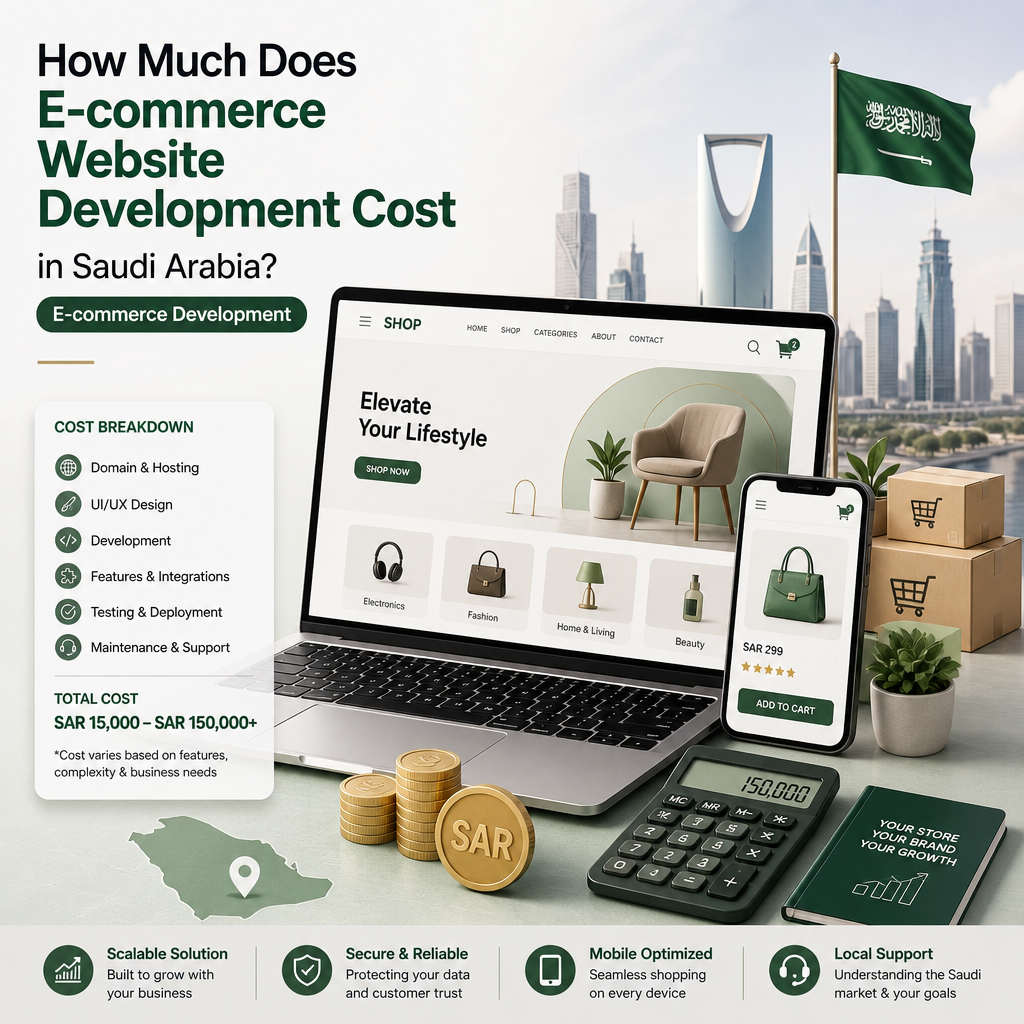
E-commerce Development Cost Tiers in Saudi Arabia: Starter, Professional, Enterprise
Before breaking down individual components, understand the three tiers most agencies in Saudi Arabia quote against. Each tier reflects a different business profile, not just a budget preference.
Tier 1: Starter Store (SAR 25,000 – SAR 55,000)
This tier suits new businesses, brick-and-mortar shops moving online, or brands testing a product category before committing to a full platform. You get a template-based or lightly customized store with up to 200 products, bilingual Arabic-English content, Mada and STC Pay integration, and basic SEO setup.
What pushes you to the low end (SAR 25,000): choosing Salla or Zid (both Saudi-built platforms with Arabic built in), using a pre-built theme with minor color/logo changes, 50 or fewer SKUs, and self-managed content upload. What pushes you to the high end (SAR 55,000): switching to Shopify Basic with a custom Arabic theme, adding Tabby or Tamara BNPL, needing a custom checkout flow, or migrating from an existing platform with data cleanup required.
Tier 2: Professional Store (SAR 60,000 – SAR 130,000)
This is the most common engagement for established Saudi SMEs, regional brands, and multi-category retailers. It includes a fully custom UI/UX design, bilingual product catalog with Arabic copywriting, multi-payment gateway setup (Mada, Visa/Mastercard, STC Pay, Tamara, Tabby), shipping integration (Aramex, SMSA Express, J&T), basic ERP or inventory sync, and ZATCA Phase 1 e-invoicing compliance.
The low end (SAR 60,000) applies when you use WooCommerce or Shopify with existing brand guidelines and a clean product data export. The high end (SAR 130,000) applies when you need a fully custom design system from zero, 1,000+ SKUs with variant logic, custom discount/loyalty engine, and a first ERP integration (e.g., Odoo or Oracle Netsuite via middleware).
Tier 3: Enterprise Store (SAR 150,000 – SAR 300,000+)
Enterprise builds on Adobe Commerce (Magento), headless Shopify Plus, or custom Laravel/React backends. These serve large retailers, marketplace operators, B2B distributors, or brands requiring multi-store, multi-currency, and multi-warehouse logic. Full ZATCA Phase 2 compliance, advanced ERP integration (SAP, Oracle, Microsoft Dynamics 365), PIM systems, and dedicated server infrastructure on AWS Middle East (Bahrain) are standard.
Projects exceed SAR 300,000 when a marketplace model (seller onboarding, commission engine, escrow payments) is required, or when deep ERP customization and data migration from legacy systems like old Magento 1 or custom-built platforms is on scope.
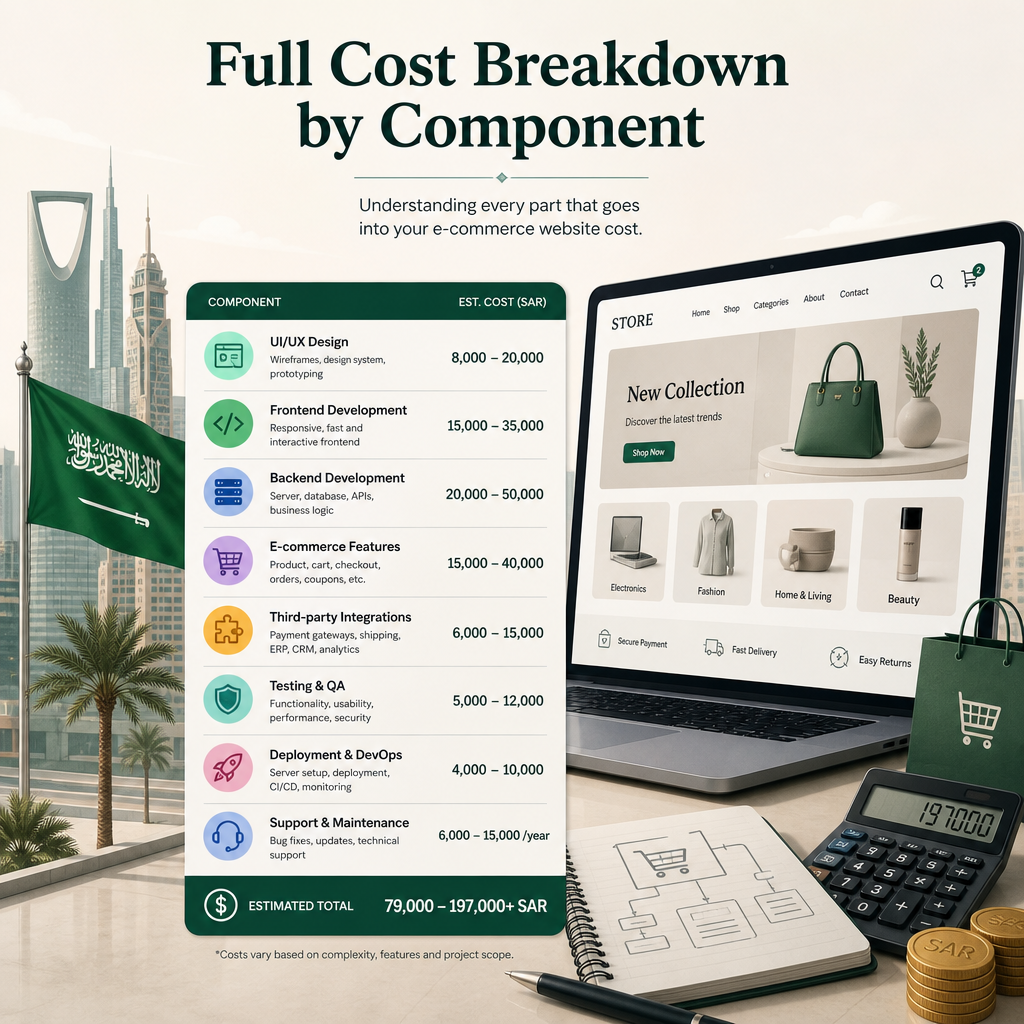
Full Cost Breakdown by Component
The table below reflects actual project data from the Saudi market as of 2026. Use it to build a line-item budget, not just a top-line number.
- UI/UX Discovery and Wireframing (Simple) – SAR 3,000 to SAR 8,000: Wireframes for 5-8 screens, one revision round. Suitable for template-driven builds where layout decisions are minimal.
- UI/UX Custom Design System (Professional) – SAR 10,000 to SAR 20,000: Full design system with brand guidelines, homepage, PDP, cart, checkout, and mobile screens. Figma deliverable included.
- UI/UX Enterprise / Headless (Complex) – SAR 22,000 to SAR 40,000: Multi-store design, design tokens, interactive prototyping, accessibility audit for WCAG 2.1, full Arabic RTL specification.
- Arabic Localization and RTL Development – SAR 5,000 to SAR 18,000: Bidirectional layout, Arabic typography (font selection for screen legibility), RTL checkout flow, Arabic product descriptions, and admin panel localization. Budget toward SAR 18,000 if your chosen platform (e.g., standard Shopify themes) needs extensive RTL overrides vs. SAR 5,000 on Salla or Zid where Arabic is native.
- Product Migration (up to 500 SKUs) – SAR 4,000 to SAR 10,000: Includes data mapping, category restructure, image optimization, and QA. Add SAR 3,000-8,000 per additional 500 SKUs if variant logic or multi-warehouse stock is involved.
- Payment Gateway Integration – Mada + STC Pay – SAR 3,000 to SAR 6,000: Both are mandatory for Saudi stores. Mada (via HyperPay, Checkout.com, or Moyasar) and STC Pay require merchant account setup + API integration + sandbox testing.
- Payment Gateway Integration – BNPL (Tamara / Tabby) – SAR 2,500 to SAR 5,000: Each gateway is a separate API integration. Budget for both if your AOV is above SAR 300, as BNPL conversion lifts are well-documented in the Saudi market.
- Shipping Integration (Aramex, SMSA, J&T) – SAR 3,000 to SAR 8,000: Real-time rate calculation, label printing, order tracking, and returns portal. Higher end if same-day Riyadh delivery or multi-carrier failover logic is required.
- ZATCA E-Invoicing Phase 1 Compliance – SAR 4,000 to SAR 8,000: XML invoice generation, QR code stamping, and buyer-seller field mapping. Required for VAT-registered businesses.
- ZATCA E-Invoicing Phase 2 (CSID Integration) – SAR 8,000 to SAR 20,000: Real-time clearance with ZATCA’s FATOORA platform, cryptographic stamping, UUID generation, and reporting mode for B2B invoices. See the ZATCA section below for applicability criteria.
- ERP Integration (Odoo / QuickBooks / Microsoft Dynamics) – SAR 10,000 to SAR 40,000: Scope varies enormously. A read-only Odoo inventory sync is SAR 10,000. A bidirectional SAP integration with custom field mapping and error handling is SAR 35,000-40,000+.
- Mobile App (iOS + Android, React Native) – SAR 30,000 to SAR 80,000: Shared codebase React Native app with push notifications, wishlist, and Arabic RTL. Higher end adds loyalty program, AR product preview, or custom checkout experience.
- Third-Party Apps and Plugins – SAR 2,000 to SAR 15,000 setup + ongoing SaaS fees: Klaviyo or Mailchimp for email (SAR 150-1,500/month), Yotpo for reviews, Tidio for live chat, Meta Pixel and Google Tag Manager configuration.
- Hosting – AWS Middle East Bahrain (per year) – SAR 1,800 to SAR 12,000: AWS EC2 + RDS + CloudFront CDN for custom stores. Starter WooCommerce on a managed server: SAR 1,800/year. High-traffic Magento with Redis, Elasticsearch, and auto-scaling: SAR 10,000-12,000/year. Shopify and Salla/Zid hosting is included in their subscription fees.
- Domain (.sa or .com.sa) – SAR 70 to SAR 500/year: .sa domains require Saudi Commercial Registration (CR) documentation for registration.
- SSL Certificate – SAR 0 to SAR 1,500/year: Free via Let’s Encrypt on most hosts; paid EV SSL (SAR 800-1,500/year) for enterprise trust signals.
- Monthly Maintenance and Support – SAR 550 to SAR 15,000/month: See the dedicated section below.
Platform Comparison: Salla vs. Zid vs. Shopify vs. WooCommerce vs. Magento for Saudi Arabia
This is the decision your budget depends on most. Each platform has a different cost profile, Arabic readiness level, and local payment rail maturity. Here is a frank comparison based on real Saudi market deployments.
Salla
Salla is a Saudi-built SaaS platform and the most Arabic-native option available. RTL layout, Arabic admin panel, Mada, STC Pay, Tamara, and Tabby integrations are built in from day one. ZATCA Phase 1 invoicing is supported natively; Phase 2 is on the roadmap with partial third-party support available.
Subscription cost: SAR 199 to SAR 799/month (Growth, Professional, Enterprise plans). Development cost: Lowest of all platforms – SAR 15,000 to SAR 40,000 for a fully customized Salla store because most Arabic and payment work is pre-done. Best for: Saudi-only SMEs, fashion/beauty brands, and businesses that want speed to market. Limitation: App ecosystem is smaller than Shopify; headless/API-first architecture is limited for complex custom logic.
Zid
Zid is Salla’s main Saudi competitor, also built for the local market with strong Arabic RTL, all major Saudi payment gateways, and solid logistics integrations (Aramex, SMSA, Fetchr). The admin experience leans slightly more technical than Salla.
Subscription cost: SAR 149 to SAR 699/month. Development cost: SAR 15,000 to SAR 45,000. Best for: Businesses that want a Salla alternative with slightly more flexible API access and stronger B2B features. Limitation: Theme marketplace is more limited; third-party analytics tool support requires custom API work.
Shopify (Basic, Advanced, Plus)
Shopify is the global standard and the most developer-familiar platform for agencies. Arabic RTL has improved significantly with the 2024 Markets Pro update, but it still requires theme-level RTL overrides for pixel-perfect Arabic rendering. Payment gateways require third-party providers (HyperPay, Checkout.com, Moyasar) since Shopify Payments is not available in Saudi Arabia.
Subscription cost: USD 39 to USD 2,300/month (Basic to Plus), billed in USD. Factor in USD/SAR exchange rate risk for long-term budgeting. Development cost: SAR 25,000 to SAR 130,000+ depending on tier. Best for: Brands with international expansion plans, businesses needing Shopify’s large app ecosystem, or teams already familiar with Shopify’s Liquid/Hydrogen stack. Limitation: Arabic support requires more development effort than Salla/Zid; no Shopify Payments means extra gateway fees (1.5-2% transaction fees through third-party gateways).
WooCommerce (WordPress)
WooCommerce is open-source and sits on WordPress, giving full code control at the cost of self-managed infrastructure. Arabic RTL plugins (WPML, Polylang) are mature. Saudi payment gateways are available through Moyasar, HyperPay, and Telr WooCommerce plugins.
Subscription cost: Free core; hosting + plugins SAR 3,000 to SAR 15,000/year. Development cost: SAR 20,000 to SAR 100,000. Best for: Content-heavy stores, businesses wanting full code ownership, or those with existing WordPress infrastructure. Limitation: Security and performance maintenance is fully your responsibility; scaling above 50,000 monthly sessions requires professional DevOps work on AWS or similar.
Adobe Commerce (Magento)
Adobe Commerce is the enterprise-grade choice for large catalogs (10,000+ SKUs), multi-store operations, and complex B2B logic. Full Arabic RTL is supported. Saudi payment integrations exist but require custom development against each gateway’s API.
Subscription cost (Adobe Commerce Cloud): USD 22,000 to USD 125,000+/year depending on GMV tier. Open-source Magento is free but requires significant hosting and development investment. Development cost: SAR 120,000 to SAR 350,000+. Best for: Large retailers, B2B distributors, multi-brand conglomerates. Limitation: High total cost of ownership; requires specialist Magento developers who are scarce in the Saudi market (expect higher agency rates).
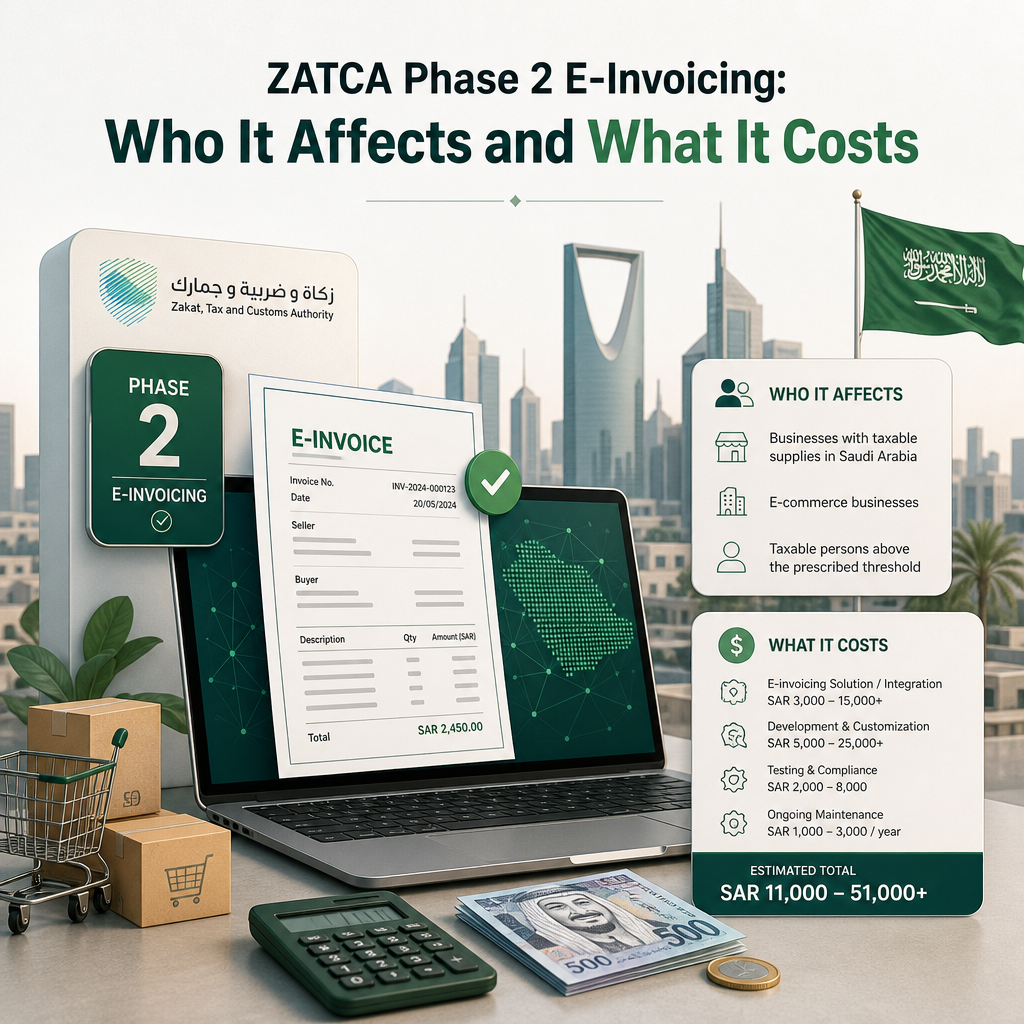
ZATCA Phase 2 E-Invoicing: Who It Affects and What It Costs
ZATCA’s Fatoora e-invoicing mandate is rolling out in waves. Phase 1 (generation) required all VAT-registered businesses to generate structured XML invoices with a QR code from December 2021. Phase 2 (integration/clearance) requires real-time submission of B2B invoices to ZATCA’s platform before they are issued to the buyer.
Does Phase 2 apply to your e-commerce store? Yes, if your annual taxable revenue exceeds SAR 3 million and you issue B2B invoices. The ZATCA rollout is wave-based by revenue threshold – check the ZATCA official e-invoicing portal for your wave eligibility date.
For e-commerce stores, the practical impact is: every B2B order checkout must trigger a cryptographically stamped XML invoice cleared through ZATCA’s API before the confirmation email goes to the buyer. This requires server-side integration, UUID generation, cryptographic signing (CSID), and error-handling for ZATCA downtime scenarios. Budget SAR 8,000 to SAR 20,000 for Phase 2 integration depending on your platform. Salla and Zid are furthest ahead on native support; Shopify and WooCommerce require a third-party middleware or custom module.
Recurring Costs: Maintenance, Support, and Year 2 Reality
The most consistently underestimated part of e-commerce budgets in Saudi Arabia is the ongoing cost after launch. I have seen businesses budget SAR 80,000 for development and zero for the 12 months that follow. That is how stores stagnate or go down unnoticed.
Monthly Maintenance Tiers
- Basic (SAR 550 to SAR 1,500/month): Security updates, plugin/app updates, uptime monitoring, and up to 4 hours of minor fixes per month. Suitable for Salla/Zid stores with stable catalogs.
- Standard (SAR 2,000 to SAR 5,000/month): Everything in Basic plus performance monitoring, monthly SEO audit, A/B test support, content updates, and gateway reconciliation checks. Suitable for active Shopify or WooCommerce stores with regular campaigns.
- Enterprise (SAR 6,000 to SAR 15,000/month): Dedicated account manager, 24/7 uptime SLA (99.9%), weekly reporting, full DevOps management on AWS, quarterly platform upgrades, and ZATCA compliance monitoring.
Total Cost of Ownership Table: Year 1 vs. Year 2
- Starter (Salla/Zid/Shopify Basic)
- Year 1: Development SAR 25,000-55,000 + Platform SAR 2,400-9,600 + Hosting SAR 0-2,000 + Maintenance SAR 6,600-18,000 + Apps/Plugins SAR 3,600-12,000 = Total SAR 37,600 to SAR 96,600
- Year 2: No dev cost + Platform SAR 2,400-9,600 + Hosting SAR 0-2,000 + Maintenance SAR 6,600-18,000 + Apps SAR 3,600-12,000 = Total SAR 12,600 to SAR 41,600
- Professional (Shopify Advanced / WooCommerce)
- Year 1: Development SAR 60,000-130,000 + Platform SAR 5,000-20,000 + Hosting SAR 2,000-6,000 + Maintenance SAR 24,000-60,000 + Apps SAR 6,000-20,000 = Total SAR 97,000 to SAR 236,000
- Year 2: Minor dev/enhancements SAR 10,000-25,000 + Platform SAR 5,000-20,000 + Hosting SAR 2,000-6,000 + Maintenance SAR 24,000-60,000 + Apps SAR 6,000-20,000 = Total SAR 47,000 to SAR 131,000
- Enterprise (Magento / Shopify Plus / Headless)
- Year 1: Development SAR 150,000-350,000 + Platform SAR 30,000-80,000 + Hosting SAR 12,000-36,000 + Maintenance SAR 72,000-180,000 + Apps/Integrations SAR 20,000-50,000 = Total SAR 284,000 to SAR 696,000
- Year 2: Enhancements SAR 30,000-80,000 + Platform SAR 30,000-80,000 + Hosting SAR 12,000-36,000 + Maintenance SAR 72,000-180,000 + Apps SAR 20,000-50,000 = Total SAR 164,000 to SAR 426,000
Saudi-Specific Cost Factors That Most Guides Ignore
Generic e-commerce cost guides written for Western markets miss several factors that are specific to Saudi Arabia and directly affect your budget.
Bilingual Arabic-English and RTL Development
Over 90% of Saudi internet users browse via mobile, and a significant portion expect full Arabic interfaces, not just translated text dropped into an LTR layout. True Arabic RTL development means right-to-left layout logic at the CSS grid/flexbox level, Arabic numeral handling, bidirectional text in mixed-content blocks, and Arabic-specific font rendering optimization. On Salla or Zid, this cost is absorbed into the platform. On Shopify or WooCommerce, budget SAR 5,000 to SAR 18,000 specifically for RTL work on top of standard development.
Saudi Payment Rail Complexity
The B2C e-commerce segment captured 76% of Saudi market share in 2024 (GMI Research, 2024), and those buyers pay through Mada first. Mada integration through a certified gateway (HyperPay, Checkout.com, Moyasar, or Telr) requires merchant account approval, sandbox testing, and production certification – a process that can take 2 to 4 weeks and occasionally delays launch. Budget the cost and the time. BNPL through Tamara or Tabby requires separate merchant agreements with each provider; both are worth the SAR 2,500 to SAR 5,000 integration cost given their impact on cart conversion in Saudi Arabia.
Mobile-First Performance Budget
Saudi mobile users are on high-speed 5G networks but also impatient with slow load times. Google’s Core Web Vitals are a ranking factor, and a Largest Contentful Paint above 2.5 seconds will hurt your SEO and conversion rate. Budget SAR 3,000 to SAR 8,000 for performance optimization (image compression, lazy loading, CDN configuration via AWS CloudFront) if it is not already included in your development scope. For Magento stores, budget more – SAR 8,000 to SAR 20,000 for Redis caching, Varnish, and Elasticsearch setup.
Commercial Registration and .sa Domain Requirements
Registering a .sa or .com.sa domain requires a valid Saudi Commercial Registration (CR) number. Factor in the time to obtain or renew your CR (through the Ministry of Commerce) if this is a new business. Domain cost: SAR 70 to SAR 500/year depending on registrar.
Cost-Offset Options: How Saudi Businesses Can Reduce Development Spend
Development costs are not fixed. There are several legitimate ways to reduce them that are specific to the Saudi market.
Monsha’at SME Financing Programs
The Monsha’at Small and Medium Enterprises General Authority offers financing products and digital transformation support programs for Saudi SMEs. Some programs partially subsidize technology investments including e-commerce platform setup. Check their portal for current eligibility criteria under the Kafalah program and digital economy support initiatives.
STC and Zain Bundled Digital Solutions
STC (Saudi Telecom Company) and Zain Saudi Arabia both offer SME digital bundles that include domain, hosting, and basic e-commerce setup at subsidized rates for new subscribers. These bundles typically cover Salla or Zid integration and can reduce initial setup costs by SAR 3,000 to SAR 10,000 for very early-stage businesses. They are not a substitute for professional development, but they are worth evaluating for Tier 1 starter stores.
Phased Development Approach
Rather than building everything in Phase 1, scope a minimum viable store (core catalog, Mada payment, Arabic/English, basic shipping) and launch in 6-8 weeks. Add ERP integration, loyalty programs, and advanced analytics in Phase 2 after your first 90 days of real traffic data. This approach reduces initial spend by 30-40% and ensures you build features that your actual customers need, not features you assumed they would need.
Key Factors That Move Your Quote Up or Down
When an agency gives you a range, here is what pushes you to each end:
- Catalog size: Under 100 SKUs keeps costs low. Above 5,000 SKUs with variants, bundles, and configurable products adds significant development and migration time.
- Design source: Bringing a complete brand book with Figma files cuts design cost by 30-50% vs. starting from zero.
- Existing data quality: Clean product data in a standard CSV export is SAR 4,000 in migration effort. Unstructured data across multiple Excel files and a legacy system is SAR 15,000+.
- Integration count: Each ERP, accounting, warehouse, or CRM integration is its own scoping exercise. One integration adds SAR 10,000-40,000. Three integrations rarely cost three times as much, but expect SAR 60,000-90,000 for a full integration bundle.
- Revision cycles: Agencies typically include 2 design revision rounds in their base quote. Extensive revision cycles due to unclear briefs or stakeholder disagreements can add SAR 5,000-15,000 in unbilled scope.
- Timeline pressure: Rush projects (under 6 weeks) typically cost 20-35% more than standard timelines.
If you are planning a Shopify store for the Saudi market, the platform and localization decisions above apply directly to your development scope. Similarly, businesses evaluating Magento for enterprise e-commerce should factor in the higher specialist rate for Adobe Commerce developers in the Kingdom.
How to Evaluate an Agency Quote in Saudi Arabia
You will receive quotes ranging from SAR 15,000 to SAR 250,000 for what sounds like the same project. Here is how to read them:
- Check what is explicitly excluded: A low quote often excludes content writing, product upload, payment gateway merchant account setup, VAT/ZATCA compliance, and post-launch support. Add those back and the gap narrows.
- Ask for a project timeline with milestones: A credible agency will give you a phased timeline (discovery, design, development, QA, launch, handover). Vague timelines like “4-8 weeks” without milestones are a red flag.
- Verify local market references: Ask for two or three live Saudi e-commerce stores they built. Test the Arabic RTL rendering, checkout flow in Arabic, and mobile performance on your own phone before signing.
- Confirm ZATCA and payment compliance experience: Ask directly: “Have you integrated ZATCA Phase 2 before?” and “Which payment gateways have you certified in Saudi Arabia?” These are not theoretical questions – they have real answers.
Our team has delivered e-commerce development projects across Saudi Arabia for clients in fashion, electronics, food and beverage, and B2B industrial supply. Every project taught us something about Saudi-specific requirements that generic guides miss. For businesses evaluating WooCommerce for their Saudi online store, the Arabic plugin ecosystem and hosting decisions deserve particular attention before committing to the platform.
Conclusion and Next Steps
Understanding how much e-commerce website development costs in Saudi Arabia is not a simple number lookup. It is a structured decision across platform, features, localization, compliance, and ongoing operations. The ranges in this guide reflect real project data, not theoretical estimates.
The single most important cost decision you will make is platform choice. Salla and Zid give you the fastest, cheapest path to a Saudi-ready store. Shopify gives you global ecosystem depth at higher localization cost. WooCommerce gives you full control at the cost of self-managed infrastructure. Magento gives you enterprise scale at enterprise price.
Whatever platform you choose, budget for the full Year 1 cost including maintenance, not just development. And factor in ZATCA compliance, Mada/STC Pay integration, and Arabic RTL from the start – retrofitting these after launch costs more than building them in from day one.
Ready to get an accurate quote for your specific project? Contact our team at ecommercetechguide.com for a free scoping consultation. We will review your requirements, recommend the right platform, and give you a line-item estimate you can actually use to plan your budget.
Request a detailed quote for your Saudi e-commerce project. Share your product catalog size, target platform, and key integration needs, and our team will respond within one business day with a scoped estimate.