




Choosing the wrong e-commerce platform in Saudi Arabia does not just cost you money upfront. It costs you missed sales when your checkout does not support Mada, lost customers when your Arabic text renders left-to-right, and regulatory headaches when your invoices fail ZATCA requirements. I have seen all three happen to real merchants.
The three platforms most Saudi business owners are evaluating right now are Salla, Zid, and Shopify. Each serves a genuinely different type of merchant, and the wrong choice is harder to reverse than most people expect. This guide gives you a direct, honest comparison so you can pick the right one before you build anything.
By the end, you will know exactly which platform fits your business type, what it will cost you at SAR 50,000 monthly revenue, and what you need to do on day one for ZATCA compliance.
Quick Overview: What Each Platform Is Built For
Salla is a Saudi-founded, Arabic-first platform built specifically for the Gulf market. It launched in 2016 and has grown to host tens of thousands of merchants across KSA, UAE, and Bahrain. Every default setting assumes a Saudi merchant: the dashboard is Arabic, VAT is pre-configured, and local payment methods work out of the box.
Zid is another Saudi-native platform, founded in 2017 and backed by major regional investors. It targets merchants who want more technical flexibility than Salla offers while still getting native Arabic support and local integrations. Zid has a strong B2B feature set and an open API that appeals to growth-stage businesses.
Shopify is a Canadian platform with over two million merchants worldwide. It is the global market leader and offers unmatched app selection and international selling tools. In Saudi Arabia, it works – but it is not built for Saudi Arabia. Localizing it requires extra work and, frequently, extra cost.

Setup and Ongoing Costs (as of Q1 2025)
Costs vary significantly across the three platforms, and the sticker price rarely tells the full story. Here is what Saudi merchants actually pay.
Salla Pricing
Salla offers three plans billed in SAR. The Growth plan runs SAR 149/month, the Professional plan is SAR 399/month, and the Enterprise plan is custom-quoted. Annual billing typically saves you around 20%, though Salla’s published discount percentage may vary – confirm current rates on their official pricing page before committing. There are no transaction fees on top of plan costs, which is a meaningful advantage at scale.
At SAR 50,000 monthly revenue on the Professional plan, your platform cost is SAR 399/month. Add payment processing fees (typically 1.9-2.5% depending on gateway), and your total platform overhead sits around SAR 1,350-1,650/month – roughly 2.7-3.3% of revenue.
Zid Pricing
Zid’s plans start at SAR 99/month for the Basic tier, SAR 299/month for the Growth tier, and SAR 799/month for the Advanced tier, with enterprise pricing available on request. Like Salla, Zid does not charge additional transaction fees beyond payment gateway rates. The SAR 99 entry point makes Zid the lowest-cost serious option for early-stage merchants.
At SAR 50,000 monthly revenue on the Growth plan, your platform cost is SAR 299/month. With payment processing at roughly 2%, total platform overhead is around SAR 1,299/month – approximately 2.6% of revenue. Zid’s pricing makes it marginally cheaper than Salla at this revenue level, though the feature set differences matter more than the SAR 100 monthly gap.
Shopify Pricing
Shopify’s plans are priced in USD. The Basic plan is $29/month, the Shopify plan is $79/month, and the Advanced plan is $299/month – equivalent to roughly SAR 109, SAR 296, and SAR 1,121/month at current rates. If you are not on Shopify Payments (which is not available in Saudi Arabia as of Q1 2025), Shopify charges an additional transaction fee of 2% on Basic, 1% on Shopify plan, and 0.5% on Advanced – on top of your payment gateway’s own processing fee.
At SAR 50,000 monthly revenue on the Shopify plan with a third-party gateway at 2% processing plus the 1% Shopify transaction fee: gateway fees (SAR 1,000) + Shopify transaction fee (SAR 500) + plan cost (SAR 296) = approximately SAR 1,796/month, or about 3.6% of revenue. Upgrading to Advanced to eliminate the transaction fee brings plan cost to SAR 1,121 but saves the SAR 500 surcharge – breakeven occurs around SAR 166,000/month in revenue.
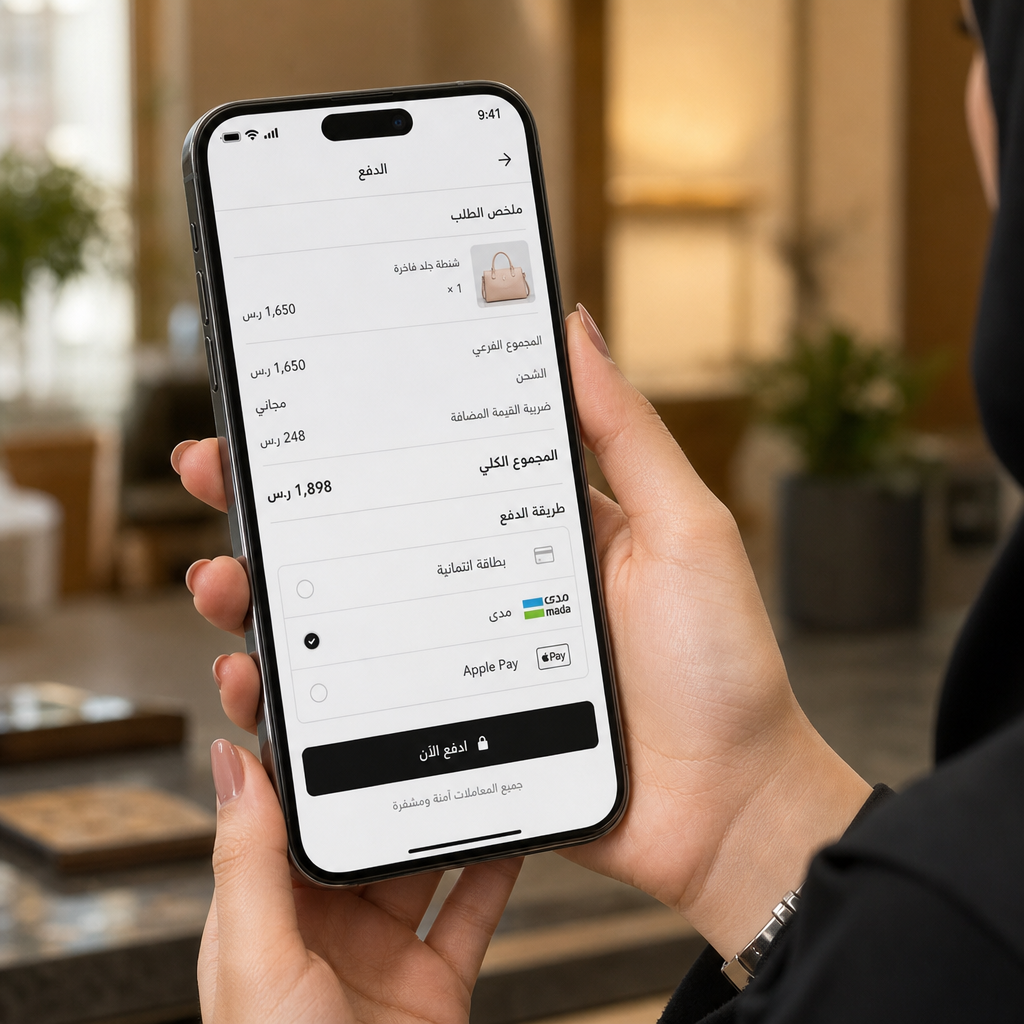
Arabic RTL Support: Native vs. Configured
This is the section where Salla and Zid pull ahead sharply for most Saudi merchants, and where Shopify’s global reputation can mislead you.
Salla and Zid: Arabic by Default
Both platforms are built Arabic-first. The admin dashboard, storefront themes, checkout flow, email notifications, and SMS messages all default to Arabic with proper right-to-left (RTL) rendering. You do not configure this – it is simply how the platform works. Product pages, category filters, and cart buttons all display correctly without touching a single CSS file.
Salla’s theme library includes over 100 Arabic-optimized themes. Zid offers a smaller but growing selection, and its open API means custom theme development in Arabic is straightforward for a local developer.
Shopify: RTL Is Conditional, Not Native
Shopify supports RTL languages, but support is not the same as native. The platform was built English-first, and Arabic RTL requires deliberate configuration. You need a theme that explicitly supports RTL – not all do, even paid ones in the Shopify Theme Store. You will likely need a local developer to audit and fix text alignment, button placement, number formatting, and Arabic font rendering across every template.
A realistic budget for Arabic RTL setup on Shopify through a local developer in Riyadh or Jeddah runs SAR 2,000 for basic theme configuration to SAR 10,000+ for a fully custom Arabic storefront with RTL-correct checkout and notifications. This is a one-time cost, but it is real and it recurs every time you change themes or upgrade your Shopify version. Our Shopify development services for Saudi merchants include Arabic RTL setup as a standard deliverable.
Mada, STC Pay, and Local Payment Integrations
Payment localization is not optional in Saudi Arabia. Mada is the dominant debit card network, and a checkout that does not support it will lose a significant portion of Saudi customers immediately.
Salla Payment Integrations
Salla integrates natively with HyperPay, Moyasar, PayTabs, and MyFatoorah – all of which support Mada, Visa, Mastercard, and STC Pay. Buy-now-pay-later options Tabby and Tamara connect directly through the Salla app store. Apple Pay is supported. Setup for these gateways is point-and-click inside the Salla dashboard, with no developer required for standard configurations.
Zid Payment Integrations
Zid supports the same core gateways: Moyasar, HyperPay, PayTabs, and Tap Payments. Tabby and Tamara are available. Mada acceptance is standard across all supported gateways. Zid also supports cash-on-delivery workflows, which remain relevant for certain product categories and regions in KSA. Their payment setup process is similarly low-friction.
Shopify Payment Integrations
Shopify does not have Shopify Payments available in Saudi Arabia. You connect through third-party gateways – Moyasar, PayTabs, and Tap Payments all have Shopify integrations, and these do support Mada. The integration quality varies by gateway and requires more technical configuration than on Salla or Zid. Tabby and Tamara have Shopify apps, but installation and testing requires developer time. Budget SAR 500-1,500 for payment gateway setup if you are not technically confident doing it yourself.

Shipping Carriers and Saudi Logistics
Shipping integration matters enormously in KSA, where the logistics market has specific dominant players and where cash-on-delivery still drives a meaningful percentage of orders in certain segments.
Salla Shipping
Salla has pre-built integrations with Aramex Saudi Arabia, SMSA Express, J&T Express, Naqel Express, and DHL. The platform’s shipping module lets you print waybills, track shipments, and manage returns from inside the dashboard. Salla Fulfillment is also available – a warehousing and fulfillment service for merchants who want to outsource logistics entirely. Cash-on-delivery reconciliation is built into the platform.
Zid Shipping
Zid connects with Aramex, SMSA, Fetchr, J&T Express, and Naqel through its logistics module, Zid Ship. Merchants get discounted shipping rates negotiated by Zid with carriers – a genuine advantage for small and mid-size merchants who cannot negotiate volume rates independently. Real-time tracking and return management are included. Zid Ship’s bulk shipment management makes it particularly useful for merchants processing 50+ orders per day.
Shopify Shipping
Shopify Shipping (with its built-in discounted rates) is not available for Saudi Arabia-based merchants. You connect Saudi carriers through third-party apps or direct API integrations. Aramex, SMSA, and DHL all have Shopify apps or documented API integrations, but each requires configuration and testing. Expect SAR 1,000-3,000 in developer time to get multi-carrier shipping working correctly, including label printing and tracking updates.
ZATCA E-Invoicing Compliance
Saudi Arabia’s Zakat, Tax and Customs Authority (ZATCA) has mandated e-invoicing (Fatoora) in phases. If your business is registered for VAT in KSA and meets the relevant revenue thresholds, non-compliance can result in fines starting at SAR 1,000 per invoice. This is not theoretical – ZATCA has been actively enforcing phase two requirements since 2023.
On Salla: ZATCA-compliant e-invoicing is built into the platform. You connect your VAT registration number in settings, and Salla generates compliant XML invoices automatically for every transaction. There is no additional cost or third-party app required.
On Zid: Zid similarly has ZATCA e-invoicing built in as a core feature. After entering your VAT details, the system handles phase-one and phase-two invoice generation including the QR code requirement. Compliant invoices are sent to customers and stored for audit purposes automatically.
On Shopify: Shopify does not include ZATCA-compliant invoicing natively. You must install a third-party app – options include Zatca E-Invoicing by Apps4u or similar solutions in the Shopify App Store. These apps typically cost SAR 100-300/month depending on invoice volume. Skipping this step is not a minor oversight; it is a compliance violation with real financial consequences for VAT-registered merchants.
Customization and Theme Development
How much you can modify your store’s design and functionality varies sharply between the three platforms.
Salla: Moderate Customization
Salla uses its own theming system. The drag-and-drop editor handles most visual changes without code. For deeper customization, Salla has a developer API and a partner ecosystem, but you are more constrained than on Shopify. Most merchants building on Salla find the out-of-the-box options sufficient for standard retail, but complex B2C experiences – custom product configurators, multi-warehouse inventory – hit limitations faster.
Zid: Open and Developer-Friendly
Zid offers a more open architecture than Salla. Its REST API, webhook system, and publicly documented developer tools make it the better choice among Saudi-native platforms for merchants who need custom integrations with ERP systems (like SAP or Oracle), custom loyalty programs, or non-standard checkout flows. Our custom e-commerce development work increasingly involves Zid API integrations for Saudi merchants with complex back-office requirements.
Shopify: Maximum Flexibility
Shopify’s Liquid templating language, extensive REST and GraphQL APIs, and the largest e-commerce app store in the world (over 8,000 apps as of Q1 2025) give it the widest customization ceiling. If you can describe a feature, there is almost certainly an app for it or a developer who has built it. This matters for merchants with unusual product types, complex subscription models, or aggressive international expansion plans.
Scalability: From SAR 50K to SAR 5M/Month
All three platforms can handle a small store. The differences emerge at scale.
Salla’s infrastructure has been tested by Saudi merchants doing millions in monthly revenue, and the platform holds up well. The main scalability constraint is customization ceiling – very large merchants with highly specific operational requirements eventually hit the edges of what Salla allows without workarounds. Salla Enterprise addresses many of these with dedicated support and custom arrangements.
Zid scales well technically, and its B2B feature set (bulk ordering, tiered pricing, customer-specific catalogs) makes it the stronger choice for wholesale merchants moving significant volume. Zid’s API-first architecture also means you can build custom tooling on top of it as your operation grows, without being forced to migrate platforms.
Shopify’s global infrastructure is unmatched. Shopify Plus (starting at $2,500/month, approximately SAR 9,375) is used by some of the world’s largest D2C brands and handles flash sales, international traffic spikes, and complex multi-store setups without blinking. If your five-year plan involves significant international revenue, Shopify Plus is worth the cost.
B2B Features
Saudi Arabia has a substantial wholesale and B2B commerce market, particularly in sectors like food distribution, construction materials, and industrial supplies.
Salla has basic B2B features – minimum order quantities, wholesale pricing tiers, and customer group discounts – but it is primarily optimized for B2C retail. Complex B2B workflows require workarounds.
Zid has the strongest B2B feature set among the three for the Saudi market. Customer-specific pricing, purchase order workflows, credit terms, and quote management are either built in or closely integrated. For a Riyadh-based distributor or Dammam industrial supplier selling to businesses rather than consumers, Zid’s B2B tooling is meaningfully better than Salla’s without the overhead of Shopify Plus.
Shopify’s native B2B features are available on Shopify Plus only. Below Plus, B2B functionality requires third-party apps, which adds cost and complexity. At the Plus tier, Shopify’s B2B tools are comprehensive – but the price point makes them relevant primarily for merchants already doing substantial revenue.
International Selling
If you plan to sell across GCC countries or into global markets, platform selection matters significantly.
Salla supports multi-currency display and has regional presence in UAE and Bahrain, but its international selling tools are limited compared to Shopify. It works well for GCC expansion but is not designed for selling into Europe, North America, or Southeast Asia.
Zid is similarly GCC-focused. The platform’s localization strengths are in Arabic-speaking markets, and international expansion beyond the Gulf requires significant custom development. If your primary market is Saudi Arabia with secondary GCC presence, Zid covers this cleanly.
Shopify’s Markets feature handles multi-currency pricing, local payment methods, automatic translation, and duty/customs calculations for international sales. Shopify is the clear choice for Saudi merchants with genuine international ambitions beyond the GCC. Our international Shopify store setup service helps Saudi merchants configure Markets correctly from day one.
Data Ownership and Portability
Where your data lives and how easily you can move it matters more than most merchants consider at the beginning.
Salla stores your data on servers within Saudi Arabia (compliant with Saudi data residency requirements), but data export options are limited. You can export orders and customer lists in CSV format, but migrating a full Salla store to another platform requires meaningful developer effort. Salla’s terms give you ownership of your store data.
Zid also maintains Saudi data residency and is more developer-friendly with data export via its API. Full data portability is achievable but requires technical work. Zid’s API access means you can build automated data pipelines to external analytics tools or ERP systems.
Shopify’s servers are primarily in North America and globally distributed. For Saudi businesses with strict data residency requirements, this can be a concern worth raising with legal counsel. Data export from Shopify is well-supported – CSV exports for products, orders, and customers, plus full API access. Moving away from Shopify is technically feasible, though no migration is trivial.
Customer Support
Support quality is underrated in platform selection, particularly for merchants without an in-house technical team.
Salla offers Arabic-language support via chat, email, and phone during Saudi business hours. Response times are generally good, and because the support team understands the Saudi market context (VAT, ZATCA, local carrier issues), resolutions are faster than you typically get from a global platform’s support team.
Zid’s support is similarly Arabic-first with strong knowledge of local requirements. Their developer documentation is solid in Arabic, which is unusual and genuinely useful for local development teams.
Shopify’s support is 24/7 in English, with Arabic support available but less consistent in quality. For Saudi-specific issues – ZATCA compliance questions, local carrier integration problems – you will often need to work with a local Shopify partner rather than Shopify’s internal support team. Working with a certified Shopify partner in Saudi Arabia bridges this gap significantly.
Head-to-Head Comparison Table
- Arabic RTL: Salla – Native | Zid – Native | Shopify – Requires SAR 2,000-10,000+ setup
- Mada / STC Pay: Salla – Built-in | Zid – Built-in | Shopify – Via third-party app
- Tabby / Tamara BNPL: Salla – Built-in | Zid – Built-in | Shopify – Via app (setup required)
- ZATCA E-Invoicing: Salla – Native | Zid – Native | Shopify – Third-party app (SAR 100-300/month)
- Saudi Shipping Carriers: Salla – Native integrations | Zid – Native + negotiated rates | Shopify – Via app/API
- B2B Features: Salla – Basic | Zid – Strong | Shopify – Plus tier only
- Customization: Salla – Moderate | Zid – Developer-friendly | Shopify – Maximum
- International Selling: Salla – GCC-focused | Zid – GCC-focused | Shopify – Global
- Data Residency (KSA): Salla – Yes | Zid – Yes | Shopify – No (global servers)
- Arabic Support: Salla – Native 24/7 | Zid – Native 24/7 | Shopify – Limited Arabic
- Starting Price (as of Q1 2025): Salla – SAR 149/month | Zid – SAR 99/month | Shopify – ~SAR 109/month
- Transaction Fee (non-native gateway): Salla – None | Zid – None | Shopify – 0.5-2%
Recommendations by Business Type
The right platform depends on your specific situation. Here is a direct mapping based on what I see working in the Saudi market:
The Riyadh Fashion or Lifestyle Brand Targeting Saudi Consumers
Choose Salla. You need Arabic-first everything, Mada and Tamara working from day one, and a polished storefront without paying a developer to configure basics. Salla’s theme selection and out-of-the-box experience are purpose-built for this use case. Your SAR 399/month Professional plan includes everything you need to launch and grow to SAR 200,000/month without hitting platform constraints.
The Dammam Industrial or Wholesale Supplier Selling B2B
Choose Zid. A Dammam supplier selling electrical components or food products to other businesses needs tiered pricing per customer, minimum order quantities, purchase order workflows, and invoice management – all before worrying about a consumer-facing storefront. Zid’s B2B feature set handles these requirements natively, and its open API connects cleanly with local ERP systems common in Saudi industrial businesses (SAP Business One, for example). Zid’s negotiated carrier rates with SMSA and Naqel also reduce per-shipment costs at the volumes a wholesale supplier typically handles.
The Saudi Brand with Serious International Expansion Plans
Choose Shopify. If you are building a Saudi brand to sell across GCC, Europe, and beyond within the next 24 months, Shopify’s Markets feature, multi-currency checkout, and global app ecosystem are worth the localization investment upfront. Budget SAR 5,000-15,000 for proper Arabic RTL setup, payment gateway configuration, and ZATCA app installation – treat it as a one-time infrastructure cost. Our team handles this full setup for Saudi merchants moving to Shopify. Contact us about our Shopify setup packages for KSA merchants.
The Early-Stage Merchant Testing Product-Market Fit
Choose Zid’s Basic plan at SAR 99/month. The lowest friction entry point with full local compliance, Arabic support, and real shipping integrations. You are not locked in long-term, and migrating to Salla Professional or Shopify later is easier from Zid than from a DIY website builder.
Key Takeaways
- Salla is the fastest path to a compliant, Arabic-first Saudi store for B2C retail merchants. Setup is measured in hours, not days.
- Zid is the best fit for B2B, wholesale, and technically ambitious merchants who want Saudi localization without sacrificing developer flexibility.
- Shopify is the right call for international ambitions, but budget SAR 5,000-15,000 for proper KSA localization before launch – and install a ZATCA-compliant invoicing app on day one.
- All three platforms support Mada, but Salla and Zid do it natively with zero developer time. Shopify requires gateway configuration.
- ZATCA compliance is non-negotiable. Salla and Zid handle it automatically. On Shopify, you need a third-party app or you risk fines starting at SAR 1,000 per invoice.
- At SAR 50,000/month revenue, Shopify’s transaction fee on third-party gateways adds roughly SAR 500/month more than Salla or Zid – factor this into your total cost comparison.
Ready to Choose Your Platform?
The platform decision shapes your store’s architecture for years. Getting it wrong means either rebuilding from scratch or paying a developer to paper over limitations that should not exist. Getting it right means launching faster, scaling without friction, and keeping your customers happy from the first checkout.
Our team in Saudi Arabia has built and migrated stores on all three platforms. Whether you are launching a new Salla store, customizing Zid for a B2B operation, or localizing Shopify for international expansion, we handle the technical work so you focus on your products. Book a free consultation with our e-commerce team today and we will map out the right platform for your specific business in under 30 minutes.
FAQ
Is Salla or Zid better for a Saudi startup launching its first online store?
For most Saudi startups focused on B2C retail, Salla is the faster launch option because its themes, payments, and shipping are pre-configured for the Saudi market. For startups with B2B models or technical integration needs, Zid's SAR 99/month entry plan and open API offer more flexibility without sacrificing local compliance.
Can Shopify process Mada card payments in Saudi Arabia?
Yes, but not natively. You must connect a third-party payment gateway such as Moyasar, PayTabs, or Tap Payments, all of which support Mada. Unlike Salla and Zid where Mada works out of the box, Shopify requires gateway configuration and testing, which typically takes a developer one to two days.
Does Shopify support ZATCA e-invoicing for Saudi VAT compliance?
Not natively. Shopify requires a third-party app for ZATCA-compliant Fatoora invoicing. Options exist in the Shopify App Store and cost roughly SAR 100-300 per month depending on invoice volume. Salla and Zid both include ZATCA compliance as a built-in feature at no additional cost.
Which platform is best for Arabic RTL support?
Salla and Zid are built Arabic-first with native RTL support across the dashboard, storefront, and checkout. Shopify supports RTL but requires deliberate theme configuration. Expect to budget SAR 2,000 to SAR 10,000 or more for a local developer to set up proper Arabic RTL on Shopify, depending on the complexity of your store.
What are the true monthly costs of each platform for a store doing SAR 50,000 in monthly revenue?
On Salla Professional (SAR 399/month) with 2% payment processing, total platform overhead is roughly SAR 1,350-1,650/month. On Zid Growth (SAR 299/month) with 2% processing, it is around SAR 1,299/month. On Shopify's mid-tier plan with a third-party gateway and Shopify's 1% transaction fee, expect approximately SAR 1,796/month. All figures are as of Q1 2025.
Can I migrate from Salla or Zid to Shopify later if my business grows internationally?
Yes, migration is possible but requires real work. Product catalogs, customer data, and order history need to be exported and re-imported, and your Arabic theme, payment gateway, and ZATCA app will need to be rebuilt on Shopify from scratch. Budgeting SAR 8,000-20,000 for a full migration with proper localization is realistic.
Which platform handles Saudi shipping carriers like SMSA, Aramex, and Naqel best?
Salla and Zid both have native integrations with major Saudi carriers including Aramex, SMSA Express, Naqel, and J&T Express. Zid additionally offers pre-negotiated shipping rates through Zid Ship, which can reduce per-shipment costs for merchants handling 50 or more orders per day. Shopify requires third-party apps or API integrations for Saudi carrier support.