




Shopify Development Saudi Arabia has moved from a niche request to a mainstream investment decision for retailers across Riyadh, Jeddah, and Dammam. The Kingdom’s e-commerce market was valued at roughly USD 15 billion (approximately 56 billion SAR) in 2024, and industry forecasts project that figure doubling to USD 29 billion by 2030, fuelled by 99% internet penetration and a rapidly expanding base of mobile-first shoppers. If you are evaluating a Shopify development company in KSA or trying to understand exactly what a professional build costs, this guide gives you a practitioner’s view, not a summary of documentation.
I have worked on Shopify projects across the Gulf, and the questions Saudi merchants ask most are consistent: How much will this cost in SAR? How does Shopify compare with local platforms like Salla and Zid? How do I stay compliant with ZATCA? How do I make my store perform in Arabic? This guide answers all of them, in order.
Why Saudi Businesses Are Choosing Shopify in 2025
The Saudi e-commerce landscape now has three serious contenders: Shopify, Salla, and Zid. Salla and Zid were built specifically for the Saudi market and offer Arabic-first interfaces, local payment integrations out of the box, and government-compliant invoicing. For a merchant selling exclusively within KSA to Arabic-speaking customers, both are credible starting points.
Shopify wins on a different set of criteria: customization depth, international scalability, and ecosystem breadth. When a Jeddah-based fashion brand wants to sell in Saudi Arabia AND ship to the UAE, Europe, and the United States under one storefront, Shopify’s multi-currency checkout, 8,000+ app marketplace, and headless commerce capabilities give it an architecture that Salla and Zid cannot match today. For B2B e-commerce with custom pricing tiers, wholesale portals, or ERP integrations, Shopify Plus is the only realistic option at scale.
The practical summary: if your growth plan is Saudi-only and you want the fastest local setup, Salla or Zid deserve a look. If you are building a brand with regional or global ambitions, or you need custom workflows that go beyond template logic, Shopify is the stronger foundation.
Key Benefits of Shopify for Saudi Businesses
Mobile-First Commerce in KSA
Over 70% of Saudi online purchases are completed on smartphones. Shopify’s themes are responsive by default, and its checkout is optimized for one-page mobile flow. Every Shopify store inherits this without additional development work, which matters when your competition is a click away on Instagram.
Mada and SADAD Payment Integration
Saudi shoppers expect Mada debit card support. Without it, a significant portion of your potential customers will abandon checkout. Shopify supports Mada payment integration through payment gateways such as PayTabs, HyperPay, and Moyasar, all of which are certified for KSA. HyperPay processes Mada, Visa, Mastercard, AMEX, and Apple Pay in a single integration. Your developer should configure this at the payment gateway level, not as a workaround plugin.
Scalability from SAR 3,000 to SAR 50,000+ Projects
Shopify runs stores doing SAR 500/month and stores doing SAR 50 million/month on the same platform. The architecture does not require a migration when you scale. This is a real operational advantage in a market where fast-growing Saudi brands often outgrow their original platform within 24 months.
App Ecosystem Built for Growth
Shopify’s app marketplace includes tools for Arabic language support, local logistics integrations (Aramex, SMSA Express, Naqel), loyalty programs, and subscription billing. The ecosystem means your development team spends time configuring proven tools rather than building from scratch.
Shopify Development Cost in Saudi Arabia: SAR Pricing by Tier
This is the question almost every Saudi merchant asks first, and the answer depends entirely on scope. Below is a realistic three-tier breakdown based on projects delivered in KSA.
- Tier 1 – Standard Store (SAR 3,000 to SAR 8,000): A theme-based Shopify setup with 20-50 products, standard payment gateway integration (HyperPay or Moyasar), basic Arabic translation, and a configured Shopify Shipping or third-party logistics connection. Suitable for new merchants testing the market. Timeline: 2-4 weeks.
- Tier 2 – Custom Store (SAR 15,000 to SAR 40,000): Custom theme design or significant theme modification, full Arabic/English bilingual setup using Shopify’s Translate & Adapt app, ZATCA-compliant e-invoicing integration, Mada payment setup, custom product pages, loyalty app configuration, and initial SEO setup. Suitable for established brands moving online or migrating from another platform. Timeline: 6-12 weeks.
- Tier 3 – Enterprise / Shopify Plus (SAR 50,000 and above): Headless or custom-front-end builds, ERP/CRM integrations (SAP, Oracle, Odoo), B2B wholesale portal, multi-storefront architecture, custom checkout scripts, advanced analytics, and full Arabic SEO implementation. Suitable for large retailers, manufacturers, or multi-brand groups. Timeline: 3-6 months.
These figures cover development only. Factor in Shopify’s monthly plan (Basic at roughly SAR 112/month up to Shopify Plus starting at approximately SAR 2,250/month), app subscriptions, and annual maintenance when budgeting your total cost of ownership.
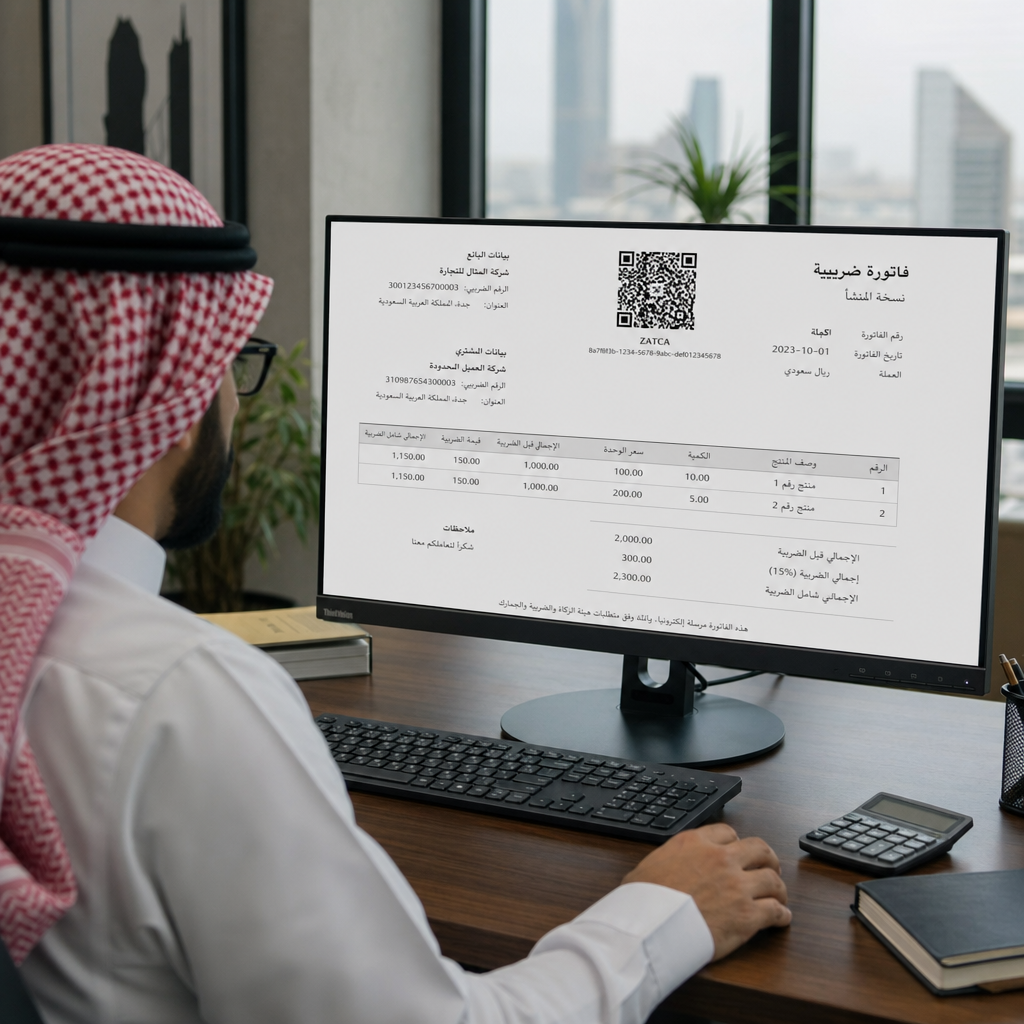
ZATCA Compliance and E-Invoicing for Shopify Stores
Saudi Arabia’s Zakat, Tax and Customs Authority (ZATCA) rolled out Phase 2 e-invoicing (Fatoora) in waves starting January 2023. By 2025, the vast majority of VAT-registered businesses in KSA are required to issue ZATCA-compliant electronic invoices in real time. Non-compliance carries penalties starting at SAR 1,000 per invoice for minor violations and can reach SAR 50,000 for repeated or deliberate breaches.
Shopify does not generate ZATCA-compliant invoices natively. You need a certified integration. Three apps used on Saudi Shopify stores are:
- Zatca E-Invoicing by InvoiceOcean – connects Shopify orders to a ZATCA-certified portal, generates QR-coded XML invoices in real time. Plans start at approximately SAR 150/month.
- Zid Invoice (via API bridge) – used by some agencies to bridge Shopify order data into Zid’s ZATCA-certified invoicing engine. Custom pricing, typically bundled into a development retainer.
- SMACC Accounting Integration – a Saudi ERP/accounting platform with a Shopify connector that handles both bookkeeping and ZATCA Phase 2 compliance. Pricing starts at approximately SAR 300/month depending on transaction volume.
Before choosing a solution, verify the app’s ZATCA certification status directly on the official ZATCA e-invoicing portal. Your development agency should walk you through this configuration during handover, not leave it as an afterthought.
Building an Arabic Shopify Store: 3 Concrete Implementation Steps
Arabic is a right-to-left (RTL) language, and a poorly implemented Arabic Shopify store loses customer trust immediately. Here is how professional Shopify developers in KSA approach this correctly.
Step 1 – Enable Shopify Translate & Adapt
Install Shopify’s native Translate & Adapt app from the Shopify App Store (free, built by Shopify). Go to your Online Store settings, add Arabic as a published language, and use the side-by-side editor to translate product titles, descriptions, collection names, navigation labels, and checkout text. Do not rely on auto-translate for product descriptions – have a native Arabic speaker review every key page before launch.
Step 2 – Configure RTL Theme Support
Most premium Shopify themes include an RTL stylesheet, but it is often not activated by default. Your developer should add dir="rtl" and lang="ar" attributes to your theme’s HTML, enable the RTL CSS file in the theme’s config, and test the layout across Chrome on Android and Safari on iOS. Button alignment, product image positions, and navigation menus all behave differently under RTL – test each section manually.
Step 3 – Set Up Arabic URL Slugs and Hreflang Tags
Shopify automatically creates language-specific URLs when you add Arabic (e.g., yourstore.com/ar/). Ensure your theme injects hreflang="ar-SA" and hreflang="en" tags in the page head so Google understands the language relationship. For Arabic SEO, your product page meta titles and descriptions must be written in Arabic with target keywords like متجر شوبيفاي السعودية and تطوير متجر إلكتروني شوبيفاي – these Arabic-language queries have lower competition and high commercial intent among Saudi shoppers searching in their native language.
Shopify Logistics and Shipping Integration in KSA
Saudi Arabia has strong logistics infrastructure, and your Shopify store should be connected to it properly. The three carriers most commonly integrated by Shopify development agencies in KSA are Aramex Saudi Arabia, SMSA Express, and Naqel Express. Each has an API or Shopify app that allows real-time rate calculation at checkout and automated shipment tracking.
For cash-on-delivery (COD), which still represents a significant share of Saudi orders, apps like Fontane COD or a custom COD flow built by your developer can gate COD orders by region, require OTP confirmation, or add a COD surcharge to offset fulfillment risk. Saudi merchants who skip this step often face 20-30% return rates on COD orders from high-risk regions.
If you are building a Shopify Plus enterprise store, your development partner should configure Shopify Shipping Scripts or Functions to apply dynamic shipping rules – free shipping thresholds in SAR, weight-based rates by zone, and different rates for next-day delivery in Riyadh versus standard delivery to remote areas.
How to Choose the Right Shopify Development Company in KSA
The Saudi market has a growing number of web agencies claiming Shopify expertise. Most are capable of installing a theme and adding products. Far fewer can build a production-grade store with ZATCA compliance, Arabic SEO, custom checkout logic, and proper performance optimization. Here is how to separate the two.
Check Their Shopify Partner Status
Legitimate Shopify experts in Saudi Arabia and the wider GCC are listed on the official Shopify Partners directory. A Partner badge means the agency has completed Shopify’s certification program and has built live stores. Ask for store URLs, not mockups – review real work.
Ask Specifically About ZATCA and Arabic RTL Experience
Most generic agencies can set up a Shopify store. ZATCA Phase 2 compliance and professional Arabic RTL implementation require specific experience. Ask the agency to describe the exact tools they use for e-invoicing and how they test RTL layouts. If they cannot answer in detail, they have not done it.
Understand the Maintenance and Support Model
Shopify stores require ongoing attention: app updates, theme patches, new platform features, and marketing integrations. Ask about post-launch support pricing in SAR. A credible agency will offer a tiered retainer (typically SAR 1,500 to SAR 5,000/month depending on scope) rather than disappearing after delivery.
Review Their Discovery and Scoping Process
A professional Shopify development company KSA will spend time understanding your product catalog structure, your ERP or inventory system, your payment and logistics preferences, and your customer segments before writing a proposal. If an agency sends you a fixed-price quote within 24 hours of a first call, they are pricing a generic build, not your actual requirements.
Shopify B2B Development for Saudi Arabia
B2B e-commerce in Saudi Arabia is a growing segment, particularly in wholesale distribution, building materials, food and beverage, and industrial supply. Shopify Plus introduced native B2B features in 2022 and has expanded them significantly: company accounts, customer-specific price lists, net payment terms, draft order automation, and a dedicated B2B storefront separate from your DTC store.
For Saudi B2B merchants, the key configuration decisions are: (1) whether to run B2B and DTC on separate storefronts or a single storefront with account-gated pricing, (2) how to handle VAT-inclusive vs. VAT-exclusive pricing for different buyer types, and (3) how to integrate with local accounting systems that procurement teams already use. These are architecture decisions that need to be made before development starts, not retrofitted afterward.
Our team has delivered Shopify B2B wholesale store builds for distributors in Riyadh and Dammam – the pattern that works consistently is a Shopify Plus B2B storefront with a HyperPay payment integration, Odoo ERP sync for inventory, and ZATCA-compliant invoicing via a certified middleware.
Digital Transformation and Shopify in Saudi Vision 2030
Saudi Arabia’s Vision 2030 program has placed digital commerce at the center of the Kingdom’s economic diversification strategy. The Saudi Authority for Accredited Valuers and the Communications, Space and Technology Commission have both published frameworks accelerating e-commerce adoption. For retailers, this creates a practical tailwind: government procurement portals increasingly favor digitally-enabled suppliers, and consumer trust in online transactions has risen sharply across all age groups.
E-commerce development in Saudi Arabia is no longer a competitive advantage – it is becoming a baseline operating requirement for businesses that want to participate in the modern Saudi economy. Shopify’s infrastructure, combined with proper local configuration, puts merchants in a strong position to capture this growth.
Key Takeaways
- Saudi Arabia’s e-commerce market is projected to grow from 56 billion SAR to over 108 billion SAR by 2030 – the market timing for launching on Shopify is strong.
- Shopify outperforms Salla and Zid on customization, international scale, and B2B capabilities – Salla/Zid are viable for Saudi-only, Arabic-first merchants who want the fastest local setup.
- Development costs range from SAR 3,000 (basic store) to SAR 50,000+ (enterprise/Shopify Plus) – scope drives price, not platform fees alone.
- ZATCA Phase 2 e-invoicing compliance is mandatory for VAT-registered merchants – apps like InvoiceOcean and SMACC provide certified solutions starting from SAR 150/month.
- Arabic implementation requires three specific steps: Translate & Adapt setup, RTL theme configuration, and Arabic hreflang/URL structure – each one matters independently.
- Mada payment integration via HyperPay, PayTabs, or Moyasar is non-negotiable for Saudi conversion rates.
- Choose a Shopify Partner-certified agency and verify their ZATCA and Arabic RTL experience with specific questions before signing a contract.
Your 7-Step Action Plan to Launch a Shopify Store in Saudi Arabia
- Define your scope and tier. Decide whether you need a SAR 3,000-8,000 standard build, a SAR 15,000-40,000 custom build, or a SAR 50,000+ enterprise project. Be honest about your current catalog size, ERP dependencies, and international ambitions.
- Select a Shopify plan. Start with Shopify (SAR 375/month) if you are launching a new store. Move to Shopify Plus (from SAR 2,250/month) if you need B2B, custom checkout, or multi-storefront architecture.
- Choose and vet your agency. Verify Shopify Partner status, request KSA store references, and ask direct questions about ZATCA Phase 2 and Arabic RTL implementation. Get a detailed scope document before signing.
- Configure your payment gateway. Integrate HyperPay, PayTabs, or Moyasar for Mada, Visa, Mastercard, and Apple Pay. Set up a COD flow with OTP confirmation if COD is relevant to your market.
- Implement ZATCA e-invoicing. Select a certified app, verify its ZATCA certification on the official portal, and test the invoice generation flow before launch with a low-value test transaction.
- Build your Arabic store experience. Install Translate & Adapt, configure RTL theme support, add hreflang tags, and have all customer-facing Arabic copy reviewed by a native speaker.
- Connect logistics and go live. Integrate Aramex, SMSA, or Naqel for real-time rates. Set up order confirmation emails in both Arabic and English. Define your KPIs for the first 90 days and review them weekly.
Shopify development in Saudi Arabia is a structured process with well-defined decision points. The merchants who execute it well treat it as a system build, not a website project. Get the architecture right at the start – payment gateways, ZATCA compliance, Arabic SEO, and logistics – and the store becomes an asset that compounds in value. Cut corners on any of these layers and you will pay to rebuild them within 12 months.
If you are ready to start a Shopify project in KSA or want a technical review of an existing store, get in touch with our Shopify development team. We work with merchants across Riyadh, Jeddah, and Dammam and can scope your project within 48 hours.
FAQ
How much does Shopify development cost in Saudi Arabia?
Shopify development in Saudi Arabia costs between SAR 3,000 and SAR 8,000 for a standard theme-based store, SAR 15,000 to SAR 40,000 for a custom bilingual build with ZATCA compliance and Mada integration, and SAR 50,000 or more for enterprise Shopify Plus projects with ERP integration and custom checkout logic.
Does Shopify support Mada payments in Saudi Arabia?
Yes. Shopify supports Mada debit card payments through certified payment gateways including HyperPay, PayTabs, and Moyasar. Each gateway handles Mada, Visa, Mastercard, AMEX, and Apple Pay in a single integration. Your Shopify developer configures this at the payment gateway settings level during store setup.
Is Shopify ZATCA Phase 2 compliant for Saudi e-invoicing?
Shopify does not generate ZATCA-compliant invoices natively. VAT-registered Saudi merchants must integrate a certified e-invoicing app such as InvoiceOcean (from SAR 150/month) or SMACC (from SAR 300/month). Always verify an app's ZATCA certification status on the official ZATCA e-invoicing portal before going live.
How does Shopify compare to Salla and Zid for Saudi merchants?
Salla and Zid are Arabic-first platforms built specifically for KSA and offer fast local setup. Shopify is the better choice for merchants with international ambitions, complex B2B workflows, custom design requirements, or the need to integrate with enterprise systems. For Saudi-only, Arabic-first stores with standard catalogs, Salla or Zid are credible alternatives.
How long does it take to build a Shopify store in Saudi Arabia?
A standard Shopify store in KSA takes 2 to 4 weeks. A custom bilingual store with ZATCA compliance and payment integration typically takes 6 to 12 weeks. Enterprise Shopify Plus builds with ERP integration and custom checkout logic require 3 to 6 months depending on scope and integration complexity.
What is the best way to make a Shopify store work in Arabic?
Use Shopify's free Translate and Adapt app to add Arabic as a published language, enable RTL stylesheet support in your theme with proper dir=rtl and lang=ar HTML attributes, and configure hreflang=ar-SA tags for Arabic URLs. Have all customer-facing Arabic copy reviewed by a native speaker before launch.
How do I find a reliable Shopify development agency in Saudi Arabia?
Verify agency credentials on the official Shopify Partners directory. Ask specifically about ZATCA Phase 2 experience and Arabic RTL implementation – any competent KSA-focused agency should be able to describe their exact approach to both. Request live store URLs from past Saudi projects and check post-launch support pricing before signing a contract.